Disclosure: The Bridge is reader-supported. When you buy through links on our site, we may earn a commission at no extra cost to you. Learn more.
Best Camping Lanterns of 2026: 22 Models Compared by Runtime and Charging
You need reliable light after sunset, but a camping lantern advertised at 600 lumens may give only a few hours at full power. Pick by the area you need to illuminate, its actual runtime at the setting you will use, charging compatibility, and the way you can place or hang it.
This guide is for US campground campers, families, tent users and people building an emergency lighting kit. Our 22 options include rechargeable white/color lanterns, compact hanging lights, solar-assisted lamps and disposable-battery models. Every comparison is based on cited manufacturer or major-retailer details, not field testing by The Bridge ARP. Stock and product generations can change.
How to Choose a Camping Lantern: Four Buying Decisions
1. Match light distribution to the job, not only the lumen number
Lumens measure total light output, but do not tell you whether a lantern spreads that light around a picnic table or focuses it as a work beam. A 150-lumen diffuser can be more pleasant than a glaring 500-lumen spotlight inside a compact tent. For group cooking and camp setup, look for dimming and enough mounting height to keep light out of eyes. A 160-degree directional work lantern and a 360-degree diffuser are not interchangeable just because their lumen ratings match.
2. Check high-mode, medium-mode and low-mode runtime separately
Maximum runtime may use a 5-lumen minimum mode, while maximum brightness drains a rechargeable cell several times faster. Compare a model such as the Goal Zero Lighthouse 600, which the maker rates at 2.5 hours with both panels high, with its much longer low-light settings. A 750-lumen boost on some Ledlenser units is a temporary peak, not their sustainable everyday high output. Require a mode table before you trust a multi-night performance promise.
3. Decide between USB-C, older ports, D batteries and solar assistance
USB-C rechargeable units reduce spare-cable clutter, but the older BioLite AlpenGlow 250 and 500 use Micro-USB. Ledlenser ML4 requires its magnetic charging cable. A Coleman 600/800 needs three or four D cells that are sold separately. Solar-integrated models can help extend low-power use when sun is available, but their small panels are not a substitute for charging before departure. Device-power-bank ports pull energy from the same light battery, so prioritize reserve light over phone charging.
4. Mounting, IP code and warm light control matter at night
IPX4 covers standardized splashes, not immersion; IP65 and IP66 specify added dust resistance and protection against water jets. Higher numbers do not authorize charging with wet connectors or ignoring a manufacturer seal. Hooks, magnets, a stable base and an upward-facing diffuser can matter more than fifty additional lumens. Warm 2700-3500K light is often gentler around a tent table than 6000K task beams.
Disqualify quickly: reject Micro-USB or proprietary charging if you cannot pack another cable; reject a 600-lumen model with a two-hour high setting when you need six continuous hours at high; reject D-cell lights for a multi-mile carry; reject a mini light as your only shared-area source; and choose separate headlamps for camp tasks when both hands must stay free and the light must follow your gaze.
Camping Lantern Comparison Table: Lumens, Runtime and Power
Manufacturer mode-specific runtime is noted precisely where published. The “maximum” runtime can mean minimum brightness, not maximum output. Some listed models are older or currently sold out; check the manufacturer/retailer listing for your US shipping address before purchase.
| Lantern | Max output | Runtime context | Power and charge | Weather | Weight |
|---|---|---|---|---|---|
| Goal Zero Lighthouse 600 | 600 lm | 2.5 h both sides high; 320 h one side low | 5,200 mAh rechargeable; built-in USB input, crank; USB output | Not stated on cited page | 1.1 lb (498 g) |
| Fenix CL26R PRO | 650 combined peak; 500 main 360° lm | 408 h maximum on lowest stated setting; high runtime depends on mode | Included 5,000 mAh 21700; USB-C in, power-bank output | Not specified here; verify IP on SKU | 7.02 oz (199 g) without battery |
| BioLite AlpenGlow 500 | 500 lm | 5 h high; 200 h low | 6,400 mAh; Micro-USB in; USB-A out | IPX4 | 13.4 oz (380 g) |
| BioLite AlpenGlow 250 | 250 lm | 5 h high; 200 h low | 3,200 mAh; Micro-USB in; USB-A out | IPX4 | 7.4 oz (210 g) |
| BioLite AlpenGlow Mini | 150 lm | 5 h high; 40 h low | 1,000 mAh rechargeable; USB-C in; no charge out | IPX4 | 3.46 oz (98 g) |
| Goal Zero Crush Light Chroma | 60 lm | 3 h high; up to 35 h low | USB-C input + integral solar cell; rechargeable | Not independently rated on cited listing | 3.2 oz (91 g) |
| Goal Zero Crush Light | 60 lm | 3 h high; up to 35 h low | USB-C input + integrated solar panel | Not verified on cited page | 3.2 oz (91 g) |
| Black Diamond Orbiter 450 | 450 lm | Maximum listed 120 h on low; high runtime not confirmed | 2,000 mAh rechargeable; USB-C in; USB-A out | IPX4 | 9.6 oz (272 g) |
| Black Diamond Orbiter 650 | 650 lm | 4 h high; up to 240 h low | 5,200 mAh rechargeable; USB-C input and USB-A output | IPX4 on brand listing | 1 lb 1.9 oz (508 g) manufacturer |
| Black Diamond Moji R+ | 200 lm | About 5 h at max; 100 h low | 1,500 mAh internal; Micro-USB input | IPX4 | 2.8 oz (79 g) on REI listing |
| Black Diamond Moji+ | 200 lm | High setting varies by battery; verify version | 3 AAA, or separately purchased BD 1500 rechargeable battery and charger | IPX4 | 2.6 oz (74 g) excluding alkaline cells |
| Black Diamond Moji | 200 lm | 5.5 h high on older cited listing; version-dependent | 3 AAA or optional BD 1500 battery pack | IPX4 | 4.2 oz (120 g) |
| Fenix CL22R | 500 lm | Up to 200 h on lowest setting | Internal rechargeable; USB-C input | IP65 | 4.76 oz (135 g) |
| Fenix CL27R | 1,600 combined maximum lm | 285 h maximum at low settings; high depends on output | Included removable 5,000 mAh 21700; USB-C input | IP66 | 10.58 oz (300 g) including battery |
| Fenix CL28R | 2,000 lm | 360 h maximum at low settings; high not specified here | Two integrated 5,000 mAh cells; USB-C charging; USB-C/USB-A device output | Not verified for this exact listing | 13.26 oz (376 g) |
| Ledlenser ML4 Warm Light | 300 boost; 150 sustained power mode lm | 2.5 h at 150-lumen power; 45 h at 5-lumen low | 750 mAh rechargeable plus compatible AA backup; proprietary magnetic cable | IP66 | 2.50 oz (71 g) |
| Ledlenser ML6 Warm Light | 750 boost; 550 power mode lm | 3.5 h at 550 lumens; up to 200 h low | 3,000 mAh rechargeable; USB charging (connector not stated here) | IP66 | 9.88 oz (280 g) |
| Coleman BatteryGuard 600 | 600 lm | Up to 30 h high | 3 D alkaline cells, sold separately; no charging port | IPX4 | Weight not confirmed on cited page |
| Coleman BatteryGuard 800 | 800 lm | Up to 30 h high | 4 D alkaline cells sold separately; no charging port | IPX4 | Weight varies with inserted D cells |
| Coleman Quad Pro 800 | 800 base; four 100-lumen removable panels lm | With 8 D cells up to 20 h high; panel 3 h high | Base: 4 or 8 D cells sold separately; each panel includes rechargeable 3 AAA NiMH | IPX4 | Large tabletop lantern; weight dependent on battery count |
| LuminAID PackLite Titan 2-in-1 | 300 lm | Up to 100 h on lowest setting | 4,000 mAh rechargeable; solar input; USB-A phone output | IP rating not verified here | 12.5 oz (354 g) |
| Barebones Beacon Hanging Light | 220 lm | 3 h high; 200+ h low | 2,200 mAh rechargeable; attached USB cable/extension | IP rating not specified on cited page | 0.55 lb (249 g) |
The 22 Camping Lanterns: Strengths, Failure Modes and Skip Rules
Every model uses four common editorial scoring criteria. These numbers summarize how useful the documented feature mix is for common camp jobs; they are not side-by-side field measurement results.
1. BEST OVERALL CAR-CAMPING BACKUP
Goal Zero Lighthouse 600
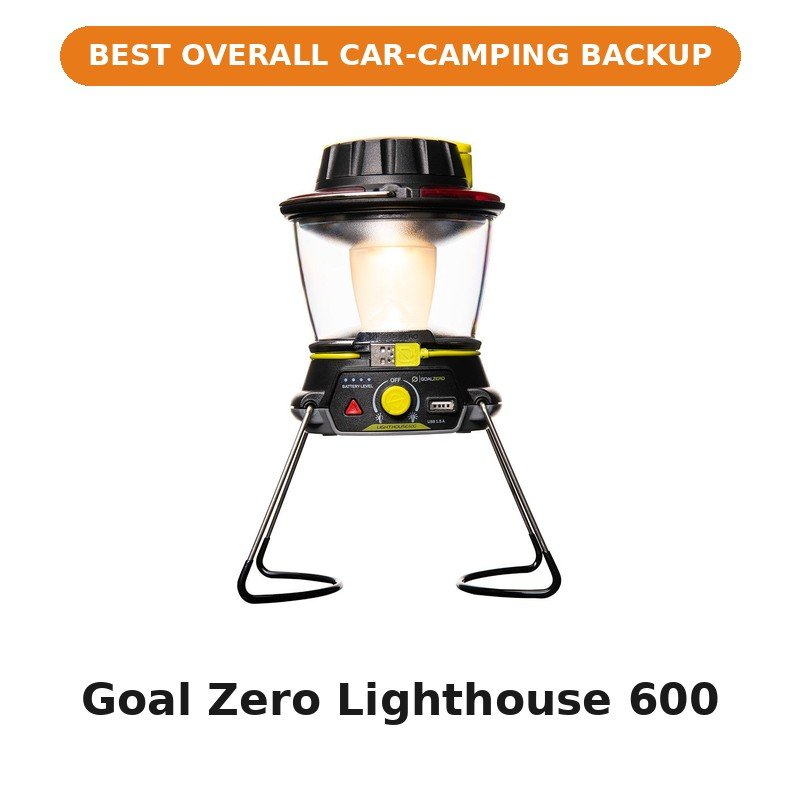
Best for: Families and vehicle-supported campers who want versatile table light plus an emergency recharge option. Two light panels give a focused one-sided setting or a wider 600-lumen maximum; folded legs and a top handle help direct light. The crank provides about 10 minutes of low light per minute of turning according to Goal Zero.
Limitations and real-life failure mode: Both-sides high consumes the internal battery in about 2.5 hours, and its 19 oz mass is poor value for a backpacking trip. Cranking is a short emergency assist, not a practical way to charge a phone fully. Before the first trip, confirm the actual charging kit and practice mounting or changing cells in dim light; arriving without the right cable or batteries is a preventable failure.
Documented specifications: 600 lumen maximum; 2.5 h both sides high; 320 h one side low; 5,200 mAh rechargeable; built-in USB input, crank; USB output; weather: Not stated on cited page; reported weight: 1.1 lb (498 g). Verify this lantern version and US availability at source.
2. BEST FLEXIBLE BEAM DIRECTIONS
Fenix CL26R PRO
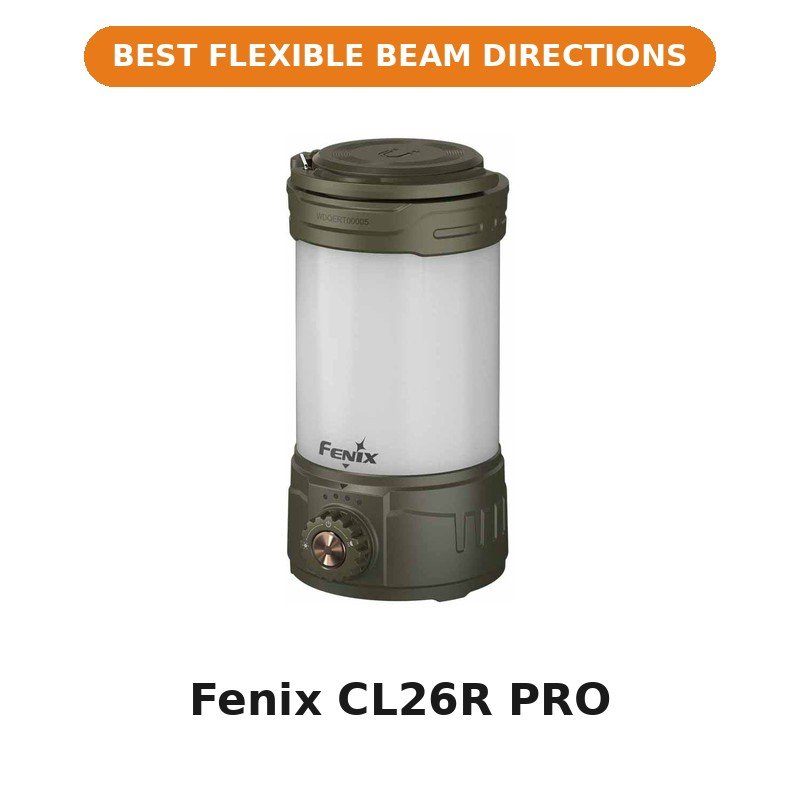
Best for: Campers who need controlled white, red and green output instead of a single diffuse glow. Its 15.9-ounce class competitors usually avoid this many direction/color modes. Retail and manufacturer descriptions agree this is a 650-lumen maximum model, with 500 lumens in 360-degree mode and useful directional beams.
Limitations and real-life failure mode: The headline 650-lumen figure is a combined maximum and must not be described as 650 lumens of continuous 360-degree output. Listed 7.02 oz excludes its included battery; account for actual carry weight. Before the first trip, confirm the actual charging kit and practice mounting or changing cells in dim light; arriving without the right cable or batteries is a preventable failure.
Documented specifications: 650 combined peak; 500 main 360° lumen output; 408 h maximum on lowest stated setting; high runtime depends on mode; included 5,000 mAh 21700; USB-C in, power-bank output; weather: Not specified here; verify IP on SKU; reported weight: 7.02 oz (199 g) without battery. Verify this lantern version and US availability at source.
3. BEST SOFT FAMILY AMBIENCE
BioLite AlpenGlow 500
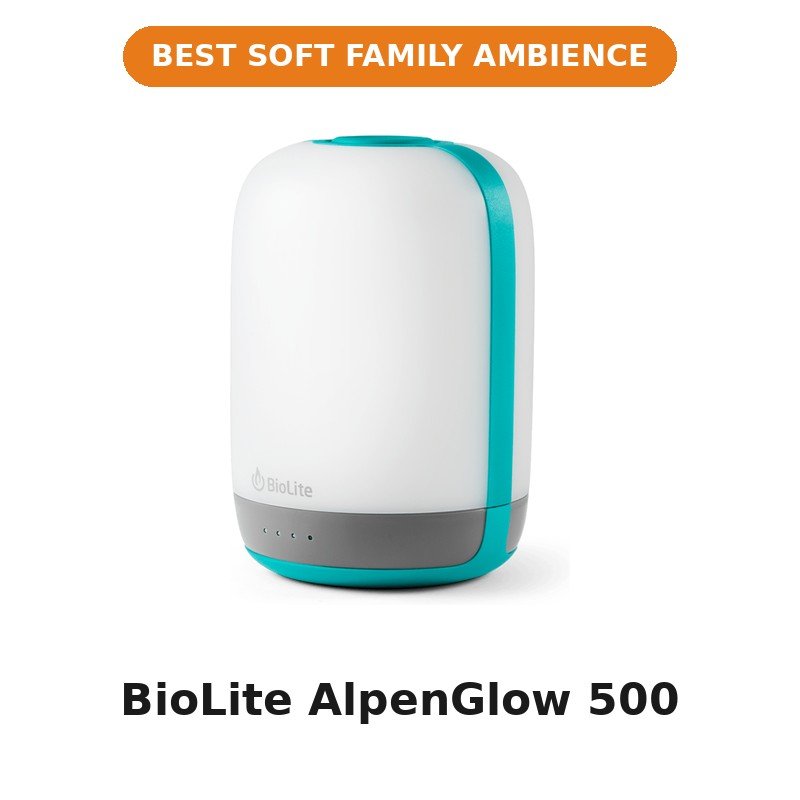
Best for: Families who prefer softened white, warm and color light across a tent or picnic setup. The 500-lumen output is paired with a 6,400 mAh battery and a battery reserve mode. A stable base suits tabletops, but its 13.4-ounce weight makes it less attractive for long walks.
Limitations and real-life failure mode: This generation charges by Micro-USB rather than USB-C and is heavier than small tent lamps. IPX4 protects from splashes, not immersion. Maximum output lasts only the manufacturer-listed five hours. Before the first trip, confirm the actual charging kit and practice mounting or changing cells in dim light; arriving without the right cable or batteries is a preventable failure.
Documented specifications: 500 lumen output; 5 h high; 200 h low; 6,400 mAh; Micro-USB in; USB-A out; weather: IPX4; reported weight: 13.4 oz (380 g). Verify this lantern version and US availability at source.
4. BEST TENT-TO-PICNIC TABLE BALANCE
BioLite AlpenGlow 250
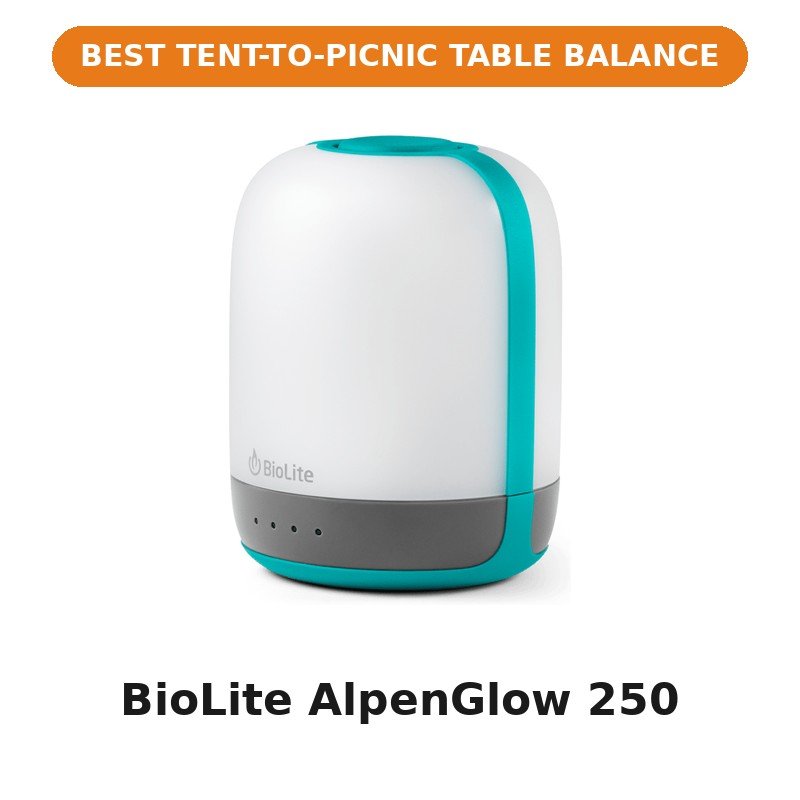
Best for: Smaller households and tent campers needing an easy-to-carry general light rather than maximum brightness. At 7.4 oz, the 250 is a more realistic backpacking-adjacent choice than the 500 while retaining warm/color modes and a table-friendly shape.
Limitations and real-life failure mode: A 250-lumen ceiling is less effective for a large shared campsite, and its charge-in connector is still Micro-USB. High-mode claims of five hours should not be confused with 200 hours at minimum brightness. Before the first trip, confirm the actual charging kit and practice mounting or changing cells in dim light; arriving without the right cable or batteries is a preventable failure.
Documented specifications: 250 lumen output; 5 h high; 200 h low; 3,200 mAh; Micro-USB in; USB-A out; weather: IPX4; reported weight: 7.4 oz (210 g). Verify this lantern version and US availability at source.
5. BEST USB-C MINI FOR TENTS
BioLite AlpenGlow Mini
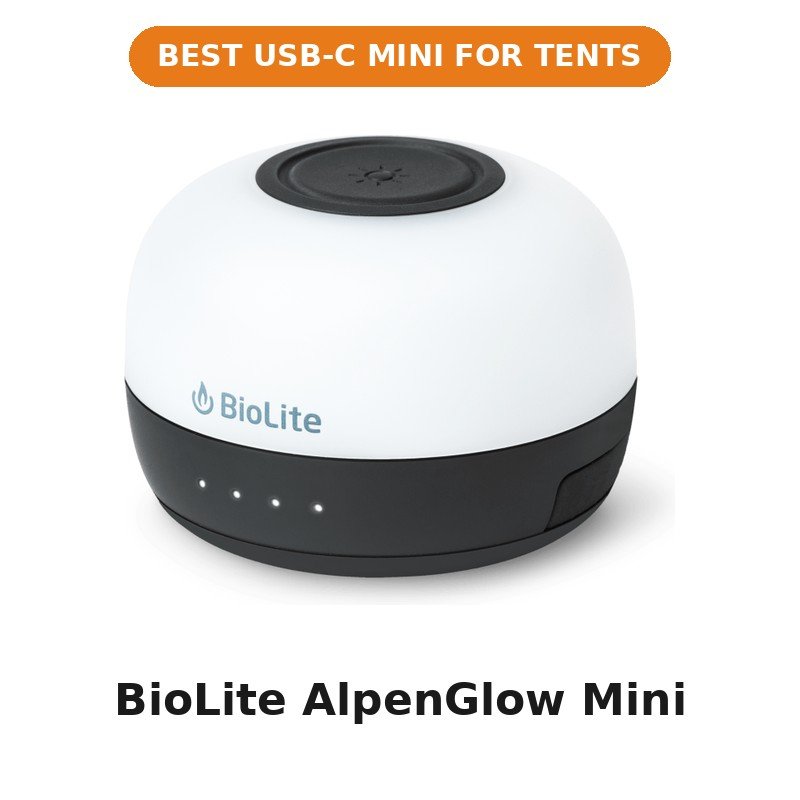
Best for: One-person or small-tent users who value 3.5-ounce carry weight, USB-C charging and a secure flexible bungee mount. BioLite lists 150 lumens, color modes and 1,000 mAh capacity. Its small output is closer to a tent night-light than a family area lamp.
Limitations and real-life failure mode: Five hours on high and 40 hours on low apply to opposite settings, so it should not replace a larger table lantern. There is no phone-charging power output. Before the first trip, confirm the actual charging kit and practice mounting or changing cells in dim light; arriving without the right cable or batteries is a preventable failure.
Documented specifications: 150 lumen output; 5 h high; 40 h low; 1,000 mAh rechargeable; USB-C in; no charge out; weather: IPX4; reported weight: 3.46 oz (98 g). Verify this lantern version and US availability at source.
6. BEST COLLAPSIBLE COLOR LANTERN
Goal Zero Crush Light Chroma
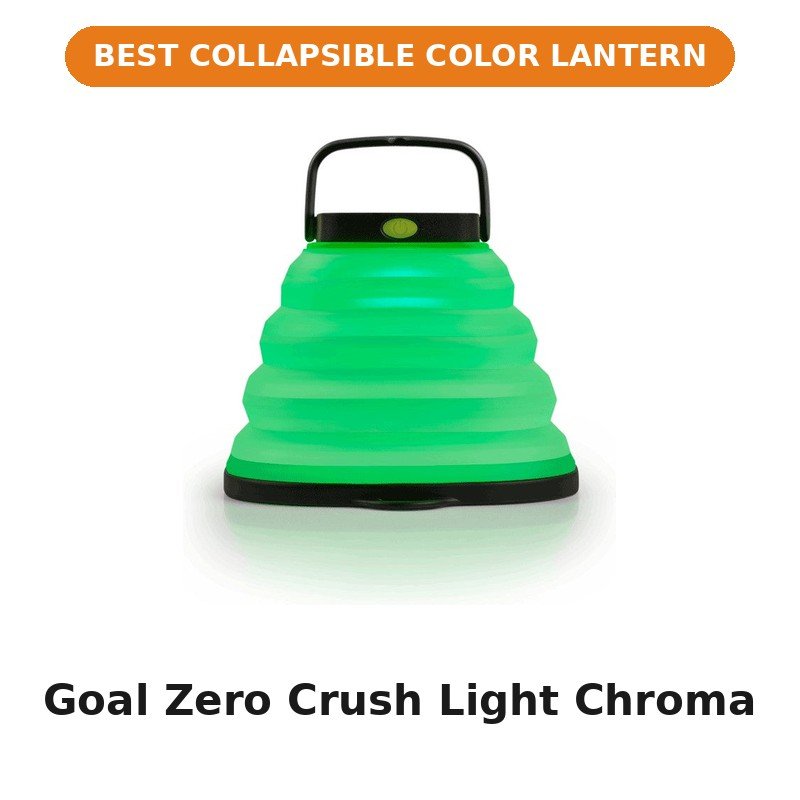
Best for: Festive, collapsible tent or patio light where fun colors matter more than task illumination. Goal Zero lists 60 lumens, six color modes, a white mode and a built-in solar panel. It folds flat enough for stuff-sack storage.
Limitations and real-life failure mode: 60 lumens is a small-area output and built-in solar collection is slow in clouds or poor positioning; do not treat it as a reliable full recharge during a storm. The listed 35-hour runtime is on low, not on high. Before the first trip, confirm the actual charging kit and practice mounting or changing cells in dim light; arriving without the right cable or batteries is a preventable failure.
Documented specifications: 60 lumen output; 3 h high; up to 35 h low; USB-C input + integral solar cell; rechargeable; weather: Not independently rated on cited listing; reported weight: 3.2 oz (91 g). Verify this lantern version and US availability at source.
7. BEST BASIC FOLD-FLAT SOLAR
Goal Zero Crush Light
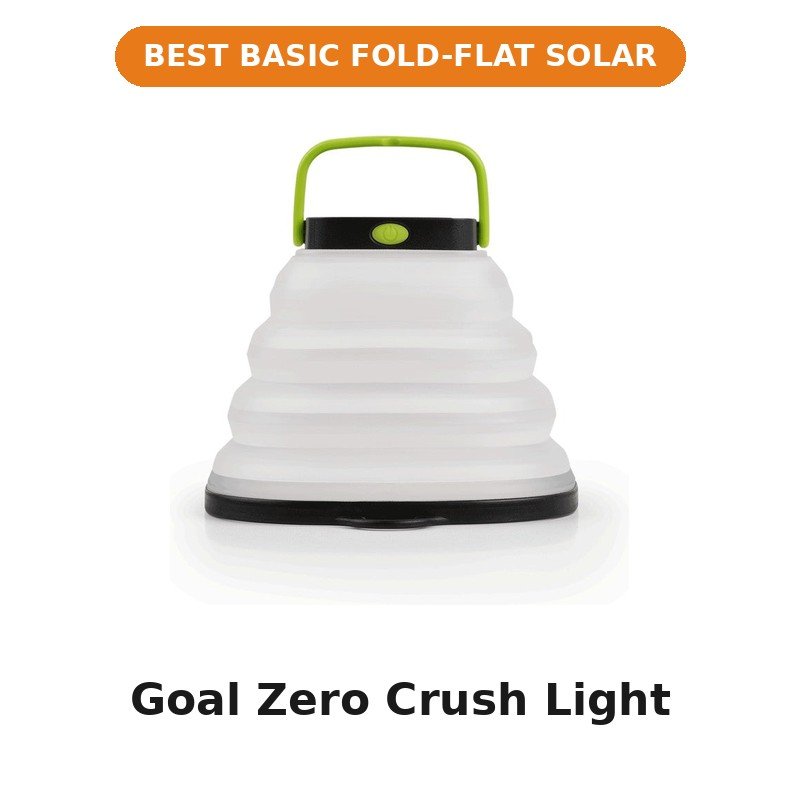
Best for: Minimalists wanting white light, not multicolor effects. The simpler Crush Light uses three white-light settings plus candle mode. Its fold-flat diffuser can slip into emergency kits or hang from a tent loop, with solar charging in addition to USB.
Limitations and real-life failure mode: The manufacturer currently labels this product sold out on the cited page. Brightness and burn time are modest; without sustained sunlight it cannot be depended on for recharging. Before the first trip, confirm the actual charging kit and practice mounting or changing cells in dim light; arriving without the right cable or batteries is a preventable failure.
Documented specifications: 60 lumen maximum; 3 h high; up to 35 h low; USB-C input + integrated solar panel; weather: Not verified on cited page; reported weight: 3.2 oz (91 g). Verify this lantern version and US availability at source.
8. BEST COMPACT RECHARGEABLE CAMP LIGHT
Black Diamond Orbiter 450
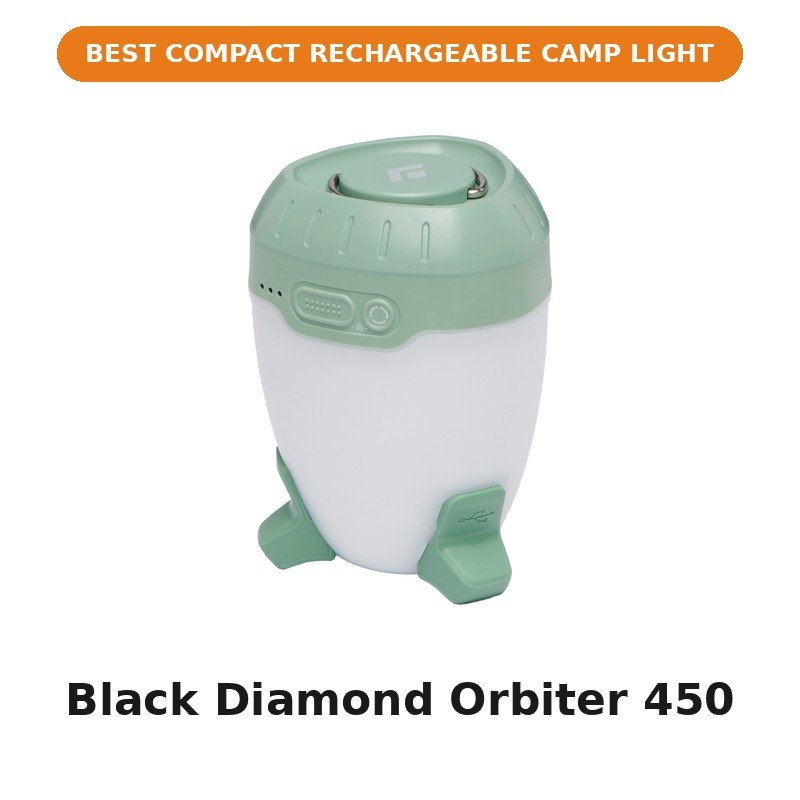
Best for: Campers seeking a medium-bright rechargeable lantern without heavy D cells. The Orbiter provides a 450-lumen top setting, diffuse light and full-spectrum color modes, with USB-C input for charging and USB-A output for limited device top-ups.
Limitations and real-life failure mode: The 120-hour claim is a maximum burn time, not 120 hours at 450 lumens. Internal-only battery removes the option to swap AA cells when depleted. Before the first trip, confirm the actual charging kit and practice mounting or changing cells in dim light; arriving without the right cable or batteries is a preventable failure.
Documented specifications: 450 lumen maximum; Maximum listed 120 h on low; high runtime not confirmed; 2,000 mAh rechargeable; USB-C in; USB-A out; weather: IPX4; reported weight: 9.6 oz (272 g). Verify this lantern version and US availability at source.
9. BEST BRIGHTER USB-C ORBITER
Black Diamond Orbiter 650
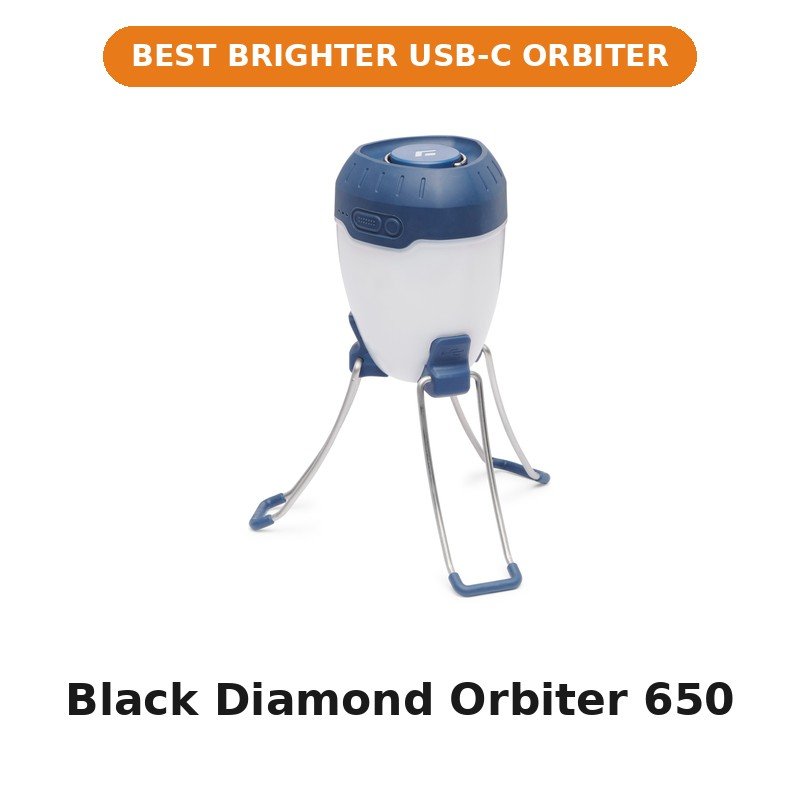
Best for: Car campers who value 650-lumen area light plus a power bank. The larger Orbiter adds output and battery capacity over the 450, with a stable lantern form and controllable diffuse white/color modes. It is practical for a table or tent-group gathering.
Limitations and real-life failure mode: The maker gives 4 hours on high and 240 hours on low; the latter is not available at 650 lumens. Its approximately 1.1 lb weight may be too much to carry beyond the vehicle. Before the first trip, confirm the actual charging kit and practice mounting or changing cells in dim light; arriving without the right cable or batteries is a preventable failure.
Documented specifications: 650 lumen maximum; 4 h high; up to 240 h low; 5,200 mAh rechargeable; USB-C input and USB-A output; weather: IPX4 on brand listing; reported weight: 1 lb 1.9 oz (508 g) manufacturer. Verify this lantern version and US availability at source.
10. BEST ULTRACOMPACT RECHARGEABLE
Black Diamond Moji R+
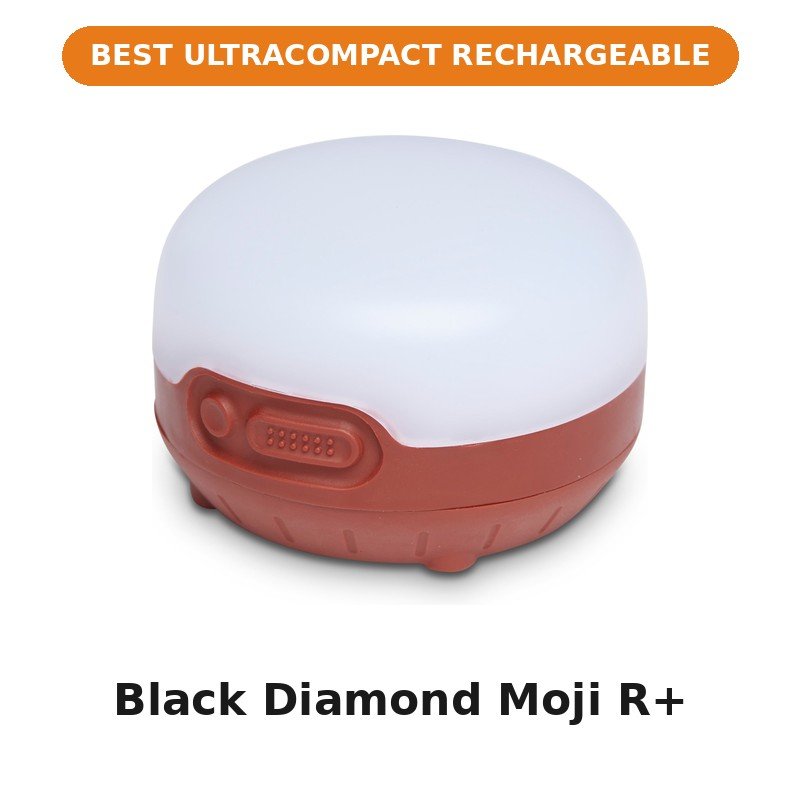
Best for: Solo hikers wanting a small hanging or magnetic light inside a tent. The double hooks and four magnets make it unusually flexible for hanging under a vestibule or on a vehicle panel, while 200 lumens can fill a small shelter. REI documents a five-hour maximum-mode claim.
Limitations and real-life failure mode: REI lists Micro-USB input for the linked model although some newer summaries elsewhere say USB-C. Use the connector on the exact SKU. A 1,500 mAh cell does not provide useful phone power. Before the first trip, confirm the actual charging kit and practice mounting or changing cells in dim light; arriving without the right cable or batteries is a preventable failure.
Documented specifications: 200 lumen maximum; About 5 h at max; 100 h low; 1,500 mAh internal; Micro-USB input; weather: IPX4; reported weight: 2.8 oz (79 g) on REI listing. Verify this lantern version and US availability at source.
11. BEST DUAL-FUEL MINI WITH COLOR
Black Diamond Moji+
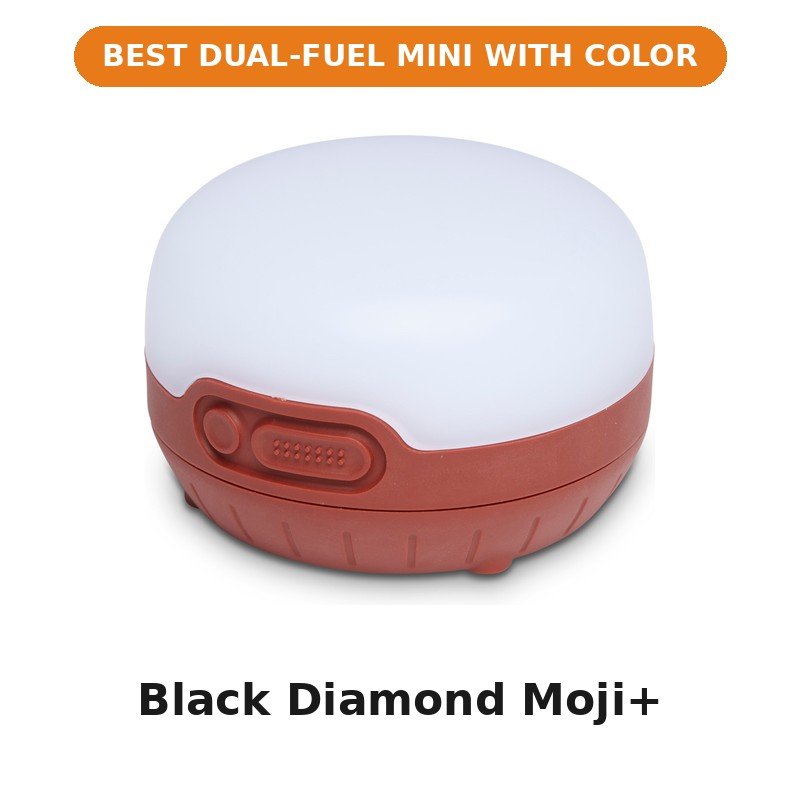
Best for: Campers who want bright little tent light without relying solely on USB charging. Runs on three replaceable AAA batteries or the optional BD rechargeable pack; its frosted lens, dual hooks, magnets and color settings give flexibility.
Limitations and real-life failure mode: The optional BD1500 battery and charger are not in the basic purchase, so buying the bundle can erase the apparent price advantage. Black Diamond currently flags PFAS shipping restrictions in some US states. Before the first trip, confirm the actual charging kit and practice mounting or changing cells in dim light; arriving without the right cable or batteries is a preventable failure.
Documented specifications: 200 lumen maximum; High setting varies by battery; verify version; 3 AAA, or separately purchased BD 1500 rechargeable battery and charger; weather: IPX4; reported weight: 2.6 oz (74 g) excluding alkaline cells. Verify this lantern version and US availability at source.
12. BEST BASIC AAA TENT LIGHT
Black Diamond Moji
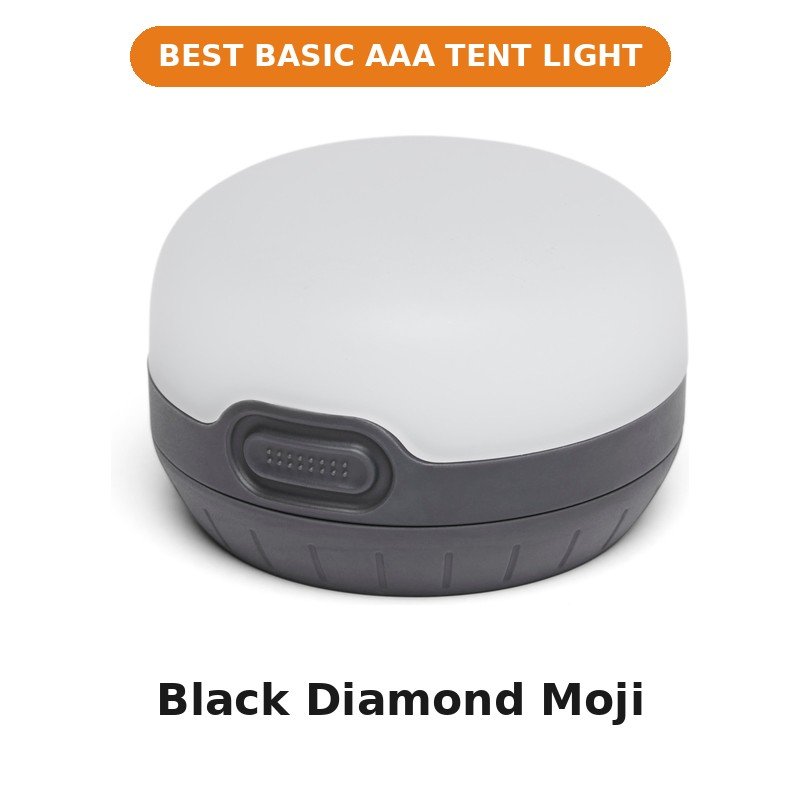
Best for: Tent campers who need uncomplicated white light without a separate charger. The 200-lumen maximum and frosted globe create a straightforward room glow. Dual Fuel supports disposable AAA or a separately purchased Black Diamond rechargeable battery.
Limitations and real-life failure mode: The manufacturer listings disagree about maximum low-setting runtime between versions, so do not count on 100 versus 120 hours without checking the chosen SKU. Batteries are not included on some offers. Before the first trip, confirm the actual charging kit and practice mounting or changing cells in dim light; arriving without the right cable or batteries is a preventable failure.
Documented specifications: 200 lumen maximum; 5.5 h high on older cited listing; version-dependent; 3 AAA or optional BD 1500 battery pack; weather: IPX4; reported weight: 4.2 oz (120 g). Verify this lantern version and US availability at source.
13. BEST WEATHER-READY COMPACT CHOICE
Fenix CL22R
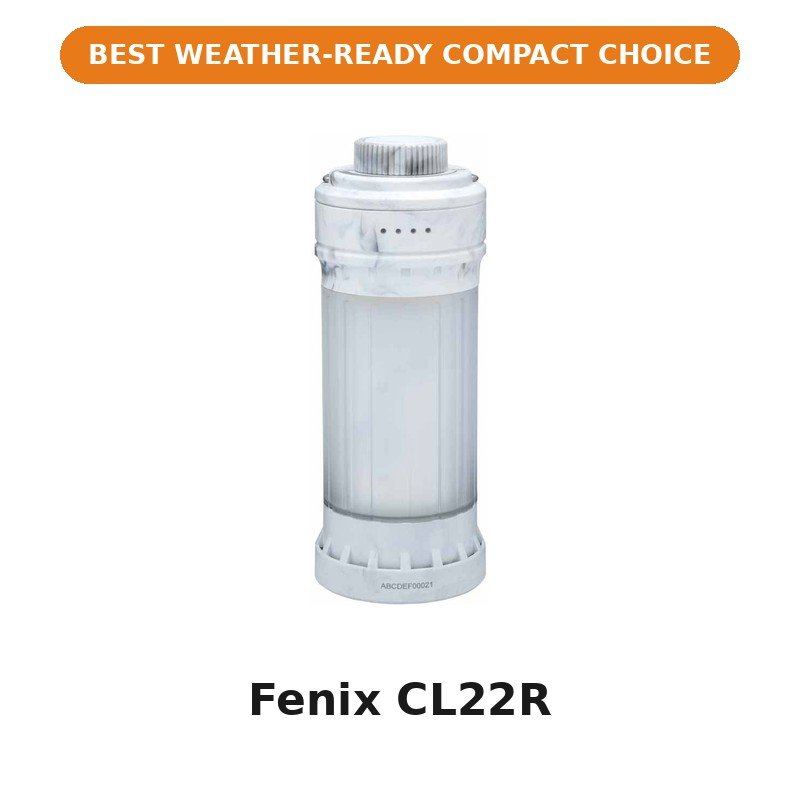
Best for: Hikers in damp climates who want a more robust IP code than splash-only models. A 3000K 360-degree ambient mode combines with a separate 6500K down-light and red-light option. IP65 dust protection and water-jet resistance are useful when the lamp is outside the tent.
Limitations and real-life failure mode: The 500-lumen figure includes its highest mode; it is not the brightness of the warm-white 360 setting at all times. Its warm and cool beams serve different tasks, and the internal battery is not field replaceable. Before the first trip, confirm the actual charging kit and practice mounting or changing cells in dim light; arriving without the right cable or batteries is a preventable failure.
Documented specifications: 500 lumen maximum; Up to 200 h on lowest setting; Internal rechargeable; USB-C input; weather: IP65; reported weight: 4.76 oz (135 g). Verify this lantern version and US availability at source.
14. BEST SPOT AND FLOOD FOR CAMP TASKS
Fenix CL27R
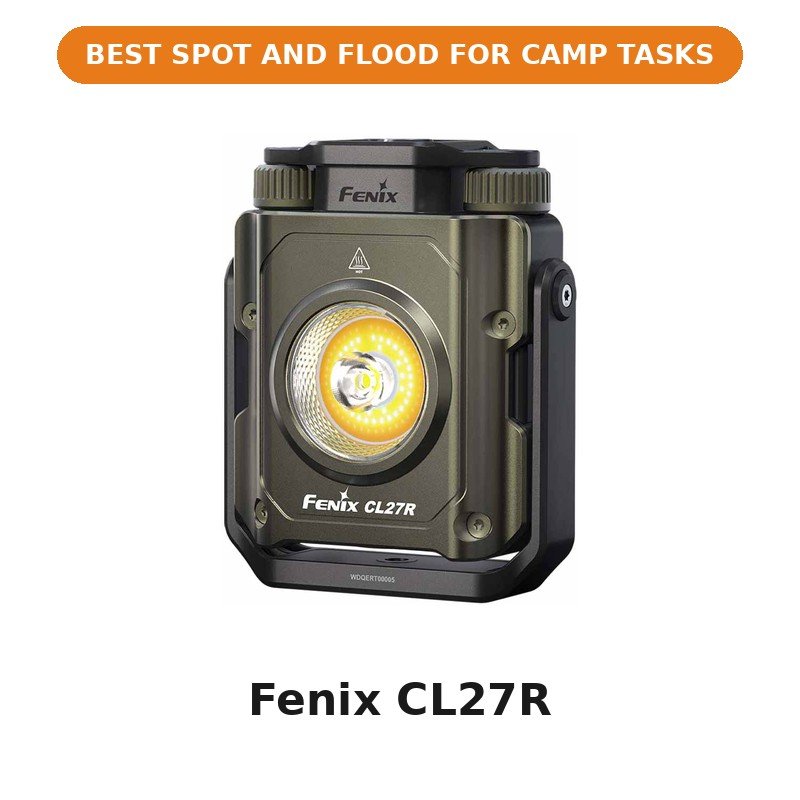
Best for: Car owners doing nighttime setup, repairs or work by a campsite. The 1,600-lumen combined flood and spotlight setup covers distance and close work, with adjustable flood color temperature, magnetic base and tripod socket. Its 21700 battery is removable.
Limitations and real-life failure mode: Directional beam design is closer to a work light than an evenly diffused table lantern. The 285-hour headline is for a very low mode, and using a 1600-lumen setting for a full evening will require frequent charging. Before the first trip, confirm the actual charging kit and practice mounting or changing cells in dim light; arriving without the right cable or batteries is a preventable failure.
Documented specifications: 1,600 combined maximum lumen maximum; 285 h maximum at low settings; high depends on output; Included removable 5,000 mAh 21700; USB-C input; weather: IP66; reported weight: 10.58 oz (300 g) including battery. Verify this lantern version and US availability at source.
15. BEST HIGH-OUTPUT COLOR-TUNABLE WORK LIGHT
Fenix CL28R
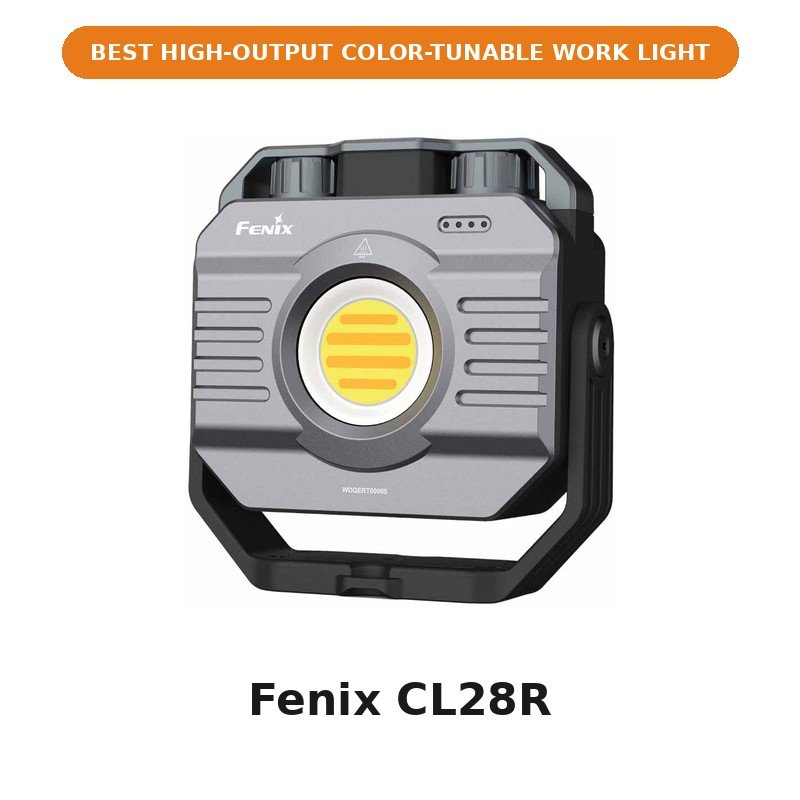
Best for: Vehicle camping or power-outage preparation where a broad directional light is useful. The main beam reaches 2,000-lumen maximum across a 160-degree arc, and a 2700 to 6000K color dial varies the white light. The magnetic base, tripod socket and power-bank outputs add utility.
Limitations and real-life failure mode: It is not a 360-degree diffused lantern despite the 2,000-lumen number. Manufacturer currently shows Out of Stock on some variants; maximum 360-hour runtime occurs on lowest setting, not at full output. Before the first trip, confirm the actual charging kit and practice mounting or changing cells in dim light; arriving without the right cable or batteries is a preventable failure.
Documented specifications: 2,000 lumen maximum; 360 h maximum at low settings; high not specified here; Two integrated 5,000 mAh cells; USB-C charging; USB-C/USB-A device output; weather: Not verified for this exact listing; reported weight: 13.26 oz (376 g). Verify this lantern version and US availability at source.
16. BEST WARM MINI LANTERN
Ledlenser ML4 Warm Light
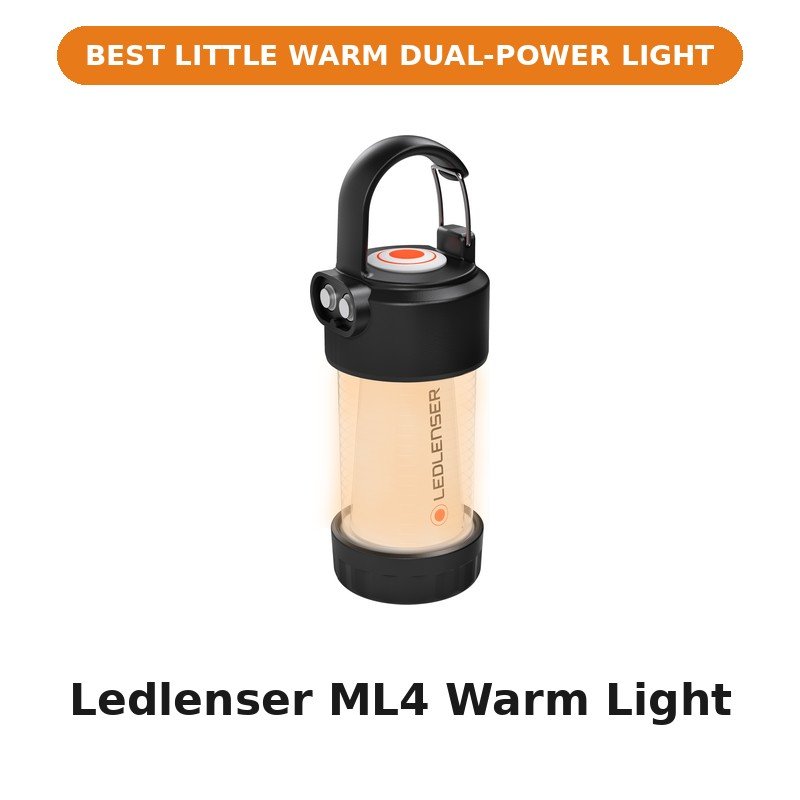
Best for: Walk-in campers who want an exceptionally tiny warm light for inside a tent or hanging over a meal. At 2.65 oz, the magnetic charge cable, carabiner and switchable warm 2700-3700K output make it a compact personal lantern.
Limitations and real-life failure mode: Magnetic-cable charging is an easy-to-misplace proprietary link. Output lasts 2.5 hours on its 150-lumen power mode; the 300 boost is a peak only. A car charger may be easier to attach but requires correct voltage. Before the first trip, confirm the actual charging kit and practice mounting or changing cells in dim light; arriving without the right cable or batteries is a preventable failure.
Documented specifications: 300 boost; 150 sustained power mode lumen maximum; 2.5 h at 150-lumen power; 45 h at 5-lumen low; 750 mAh rechargeable plus compatible AA backup; proprietary magnetic cable; weather: IP66; reported weight: 2.50 oz (71 g). Verify this lantern version and US availability at source.
17. BEST PREMIUM WARM DIFFUSER
Ledlenser ML6 Warm Light
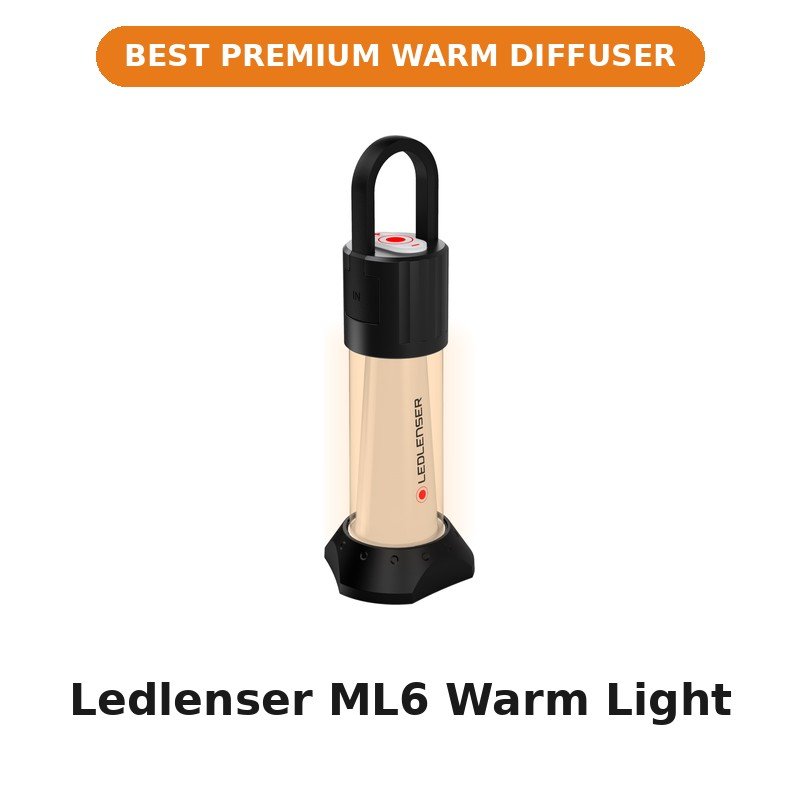
Best for: Campers who care about a warm 2500-3000K light instead of clinical white LEDs. The 550-lumen regular setting has a listed 3.5-hour runtime, and warm-white output plus red mode is suited to evenings. The brand specifies IP66 and a metal body.
Limitations and real-life failure mode: The 750-lumen headline is boost only, and the high setting runs 3.5 hours. It is larger than the ML4 and not ideal for long-distance carries; check the charging port on the model supplied. Before the first trip, confirm the actual charging kit and practice mounting or changing cells in dim light; arriving without the right cable or batteries is a preventable failure.
Documented specifications: 750 boost; 550 power mode lumen maximum; 3.5 h at 550 lumens; up to 200 h low; 3,000 mAh rechargeable; USB charging (connector not stated here); weather: IP66; reported weight: 9.88 oz (280 g). Verify this lantern version and US availability at source.
18. BEST REPLACEABLE-BATTERY VALUE
Coleman BatteryGuard 600
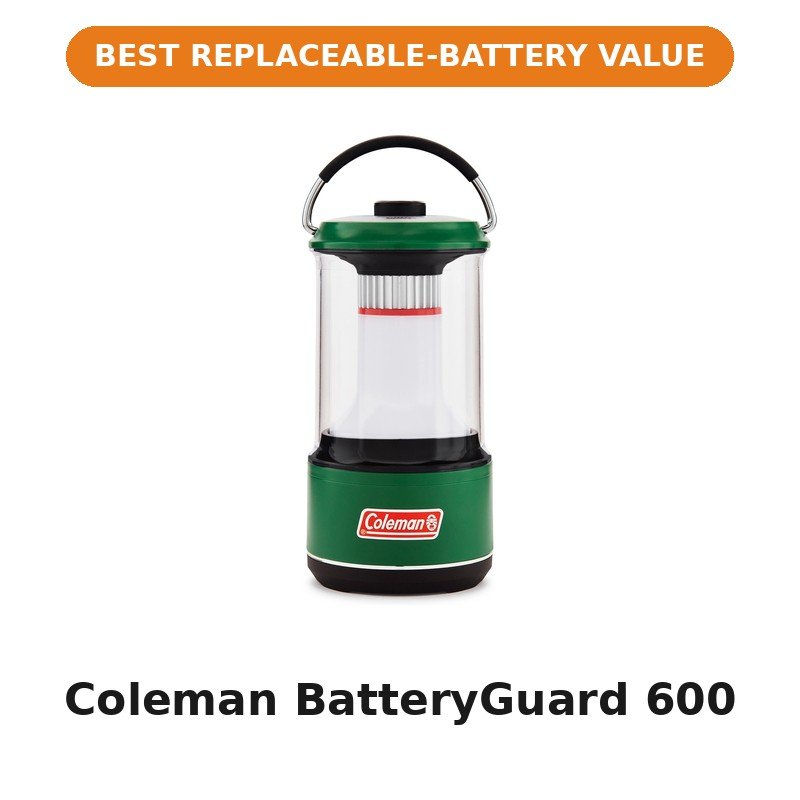
Best for: Campers who prefer buying spare batteries over keeping USB devices charged. Two modes, a 600-lumen maximum and up to thirty hours high make this a straightforward picnic-table source. BatteryGuard disconnects the cells when off to help limit standby drain.
Limitations and real-life failure mode: The three D cells are sold separately, bulky and create recurring cost. IPX4 is only splash resistance. A low star rating on the brand page is an additional signal to inspect current customer reviews before ordering. Before the first trip, confirm the actual charging kit and practice mounting or changing cells in dim light; arriving without the right cable or batteries is a preventable failure.
Documented specifications: 600 lumen maximum; Up to 30 h high; 3 D alkaline cells, sold separately; no charging port; weather: IPX4; reported weight: Weight not confirmed on cited page. Verify this lantern version and US availability at source.
19. BEST LARGE DISPOSABLE-CELL CAMP LIGHT
Coleman BatteryGuard 800
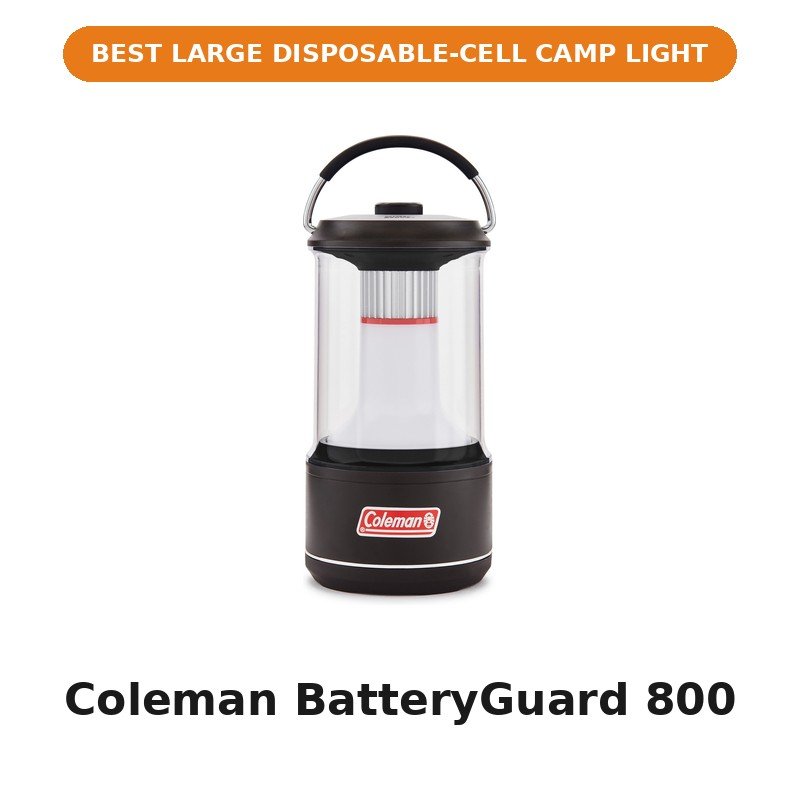
Best for: Vehicle campers wanting more brightness with a store-bought battery supply. Three lighting modes, 800-lumen maximum and up to 30 hours in high mode are clearly claimed by Coleman. BatteryGuard disconnects batteries from the circuit on shutdown.
Limitations and real-life failure mode: Four D cells are not included and significantly affect carried weight and total cost. Some users report difficulty opening the locking base, so check instructions rather than forcing the cover. Before the first trip, confirm the actual charging kit and practice mounting or changing cells in dim light; arriving without the right cable or batteries is a preventable failure.
Documented specifications: 800 lumen maximum; Up to 30 h high; 4 D alkaline cells sold separately; no charging port; weather: IPX4; reported weight: Weight varies with inserted D cells. Verify this lantern version and US availability at source.
20. BEST DETACHABLE LIGHT PANELS
Coleman Quad Pro 800
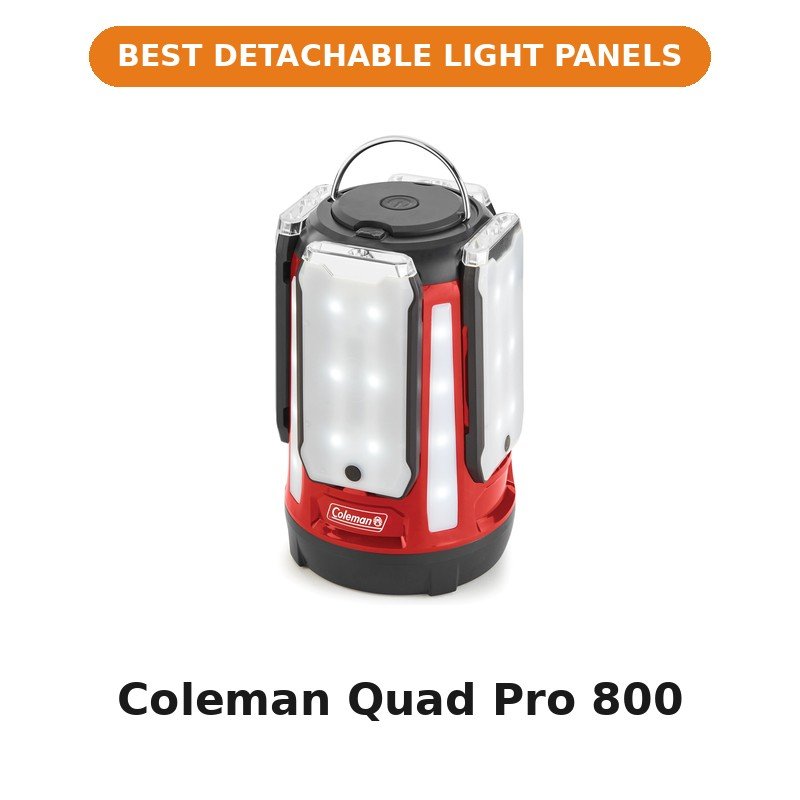
Best for: Families dividing one lantern into four short-range task lights. Four detachable panels can be carried to separate tents or mounted to a vehicle, then recharged from the parent base. Each can act as a small flashlight as well as a diffuse lamp.
Limitations and real-life failure mode: Charging the panels consumes the base D cells; using the 8-D configuration creates substantial bulk, and replacement batteries cost extra. Independent panel high runtime is only about three hours. Before the first trip, confirm the actual charging kit and practice mounting or changing cells in dim light; arriving without the right cable or batteries is a preventable failure.
Documented specifications: 800 base; four 100-lumen removable panels lumen maximum; With 8 D cells up to 20 h high; panel 3 h high; Base: 4 or 8 D cells sold separately; each panel includes rechargeable 3 AAA NiMH; weather: IPX4; reported weight: Large tabletop lantern; weight dependent on battery count. Verify this lantern version and US availability at source.
21. BEST INFLATABLE SOLAR BACKUP
LuminAID PackLite Titan 2-in-1
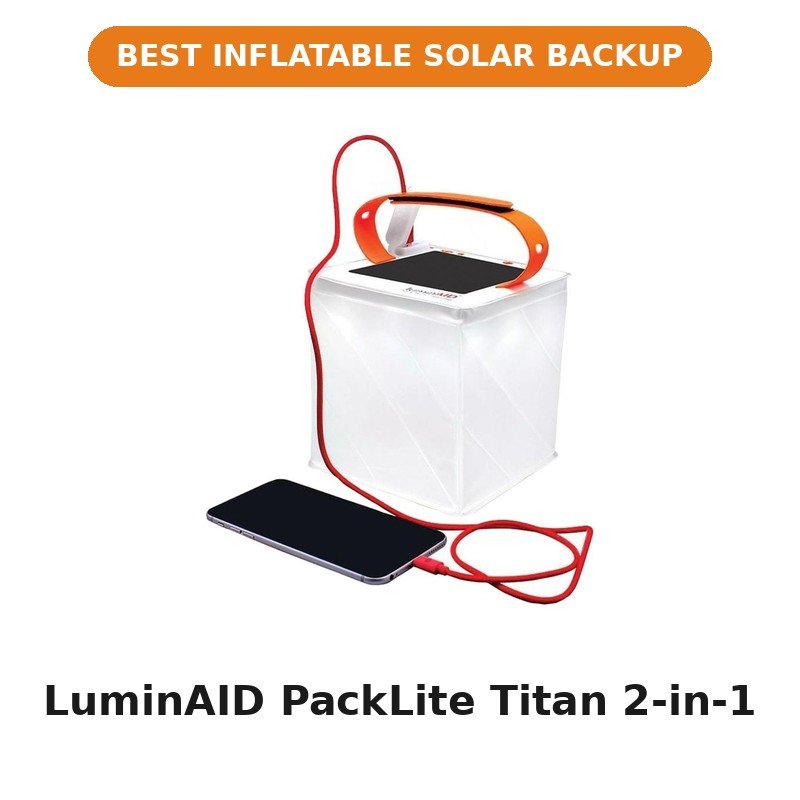
Best for: Emergency kits and campers who want a larger solar panel with fold-flat storage. The twist-to-inflate diffuser offers 300-lumen maximum output, red-light mode and a USB-A device port. Manufacturer lists 4,000 mAh capacity and up to 100 hours on the low-end modes.
Limitations and real-life failure mode: Its 100-hour figure must not be presented as 300-lumen runtime. Even a 4,000 mAh cell may not supply the number of complete phone recharges claimed in every real device scenario; solar charging depends heavily on sun. Before the first trip, confirm the actual charging kit and practice mounting or changing cells in dim light; arriving without the right cable or batteries is a preventable failure.
Documented specifications: 300 lumen maximum; Up to 100 h on lowest setting; 4,000 mAh rechargeable; solar input; USB-A phone output; weather: IP rating not verified here; reported weight: 12.5 oz (354 g). Verify this lantern version and US availability at source.
22. BEST DECORATIVE HANGING LANTERN
Barebones Beacon Hanging Light
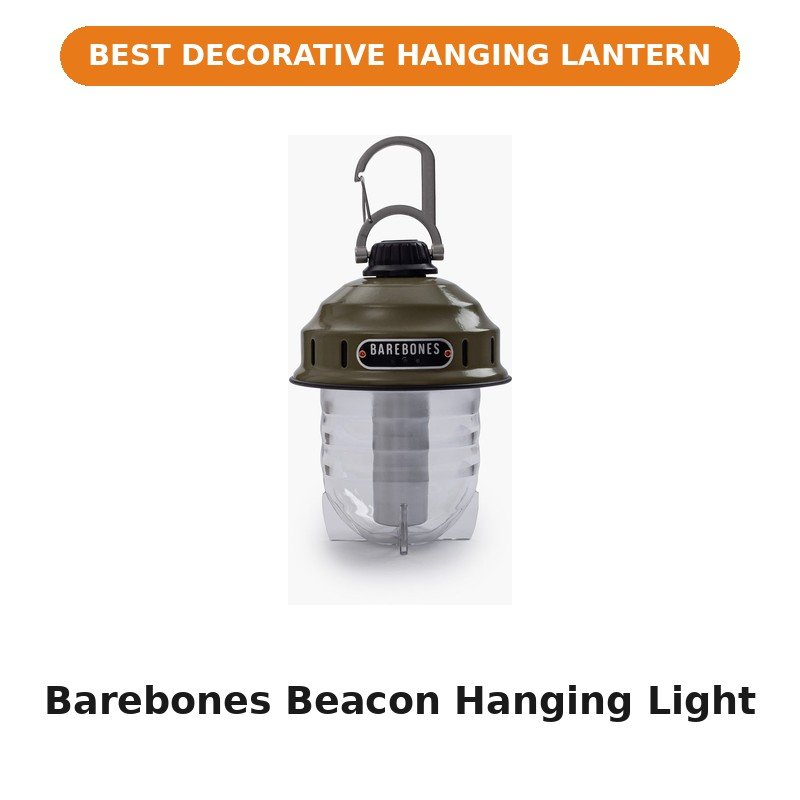
Best for: Campers wanting a warm 3000K glow for a picnic table or a small awning. Carabiner top and stable base give simple placement, and the dimmer spans from 30 to 220 lumens. A battery-level indicator provides useful feedback in the middle of the evening.
Limitations and real-life failure mode: The 200-plus hour claim is only at the 30-lumen minimum, while high lasts around three hours. The attached cable arrangement is less convenient than a universal USB-C socket, and outdoor IP protection is not stated. Before the first trip, confirm the actual charging kit and practice mounting or changing cells in dim light; arriving without the right cable or batteries is a preventable failure.
Documented specifications: 220 lumen maximum; 3 h high; 200+ h low; 2,200 mAh rechargeable; attached USB cable/extension; weather: IP rating not specified on cited page; reported weight: 0.55 lb (249 g). Verify this lantern version and US availability at source.
Frequently Asked Questions
Reader Poll: What is your biggest camping lantern deal-breaker?
The Bottom Line: Pick by Use Case
Vehicle camping with emergency power: Goal Zero Lighthouse 600, provided you can recharge after its short full-power runtime. Warm family campground glow: BioLite AlpenGlow 500; account for Micro-USB. Light tent companion with USB-C: BioLite AlpenGlow Mini or Fenix CL22R when greater weather resistance matters. Work and gear setup: Fenix CL27R for adjustable spot and flood; do not mistake it for the softest table lamp. Replaceable-cell extended camp lighting: Coleman BatteryGuard 800 when you are comfortable carrying and buying four D cells.
Final decision: determine your needed continuous brightness first, then choose the power plan, connector and weather rating. A low-mode runtime that looks impressive in advertising cannot substitute for sufficient high-mode light when you are cooking after dark.
Research transparency: specifications are from the linked manufacturers and major retailers as reviewed in October 2026. We did not conduct original laboratory lumen measurements or side-by-side battery tests. Stock, revisions, claimed figures and regional restrictions can change.
Related reading on The Bridge: camping tents, the complete camping gear checklist, camping hammocks