A beginner’s guide to materials, cushioning, height, and fit.
The right hiking socks should work with your feet, footwear, and hiking conditions as one system. A warm, heavily cushioned sock may be comfortable in roomy winter boots but feel cramped and sweaty inside lightweight trail shoes. A thin ankle sock may suit a short summer walk but leave your skin rubbing against the cuff of a taller hiking boot.
For most beginner three-season hikers, a good starting point is a snug merino-synthetic blend with light or medium cushioning. The sock should rise above the cuff of the shoe or boot and fit smoothly without wrinkles, pressure points, or slipping.
When choosing hiking socks, focus on four things:
- The footwear you will wear
- The sock’s height
- The material and cushioning
- How the sock fits your actual foot
The National Park Service recommends wool or synthetic moisture-wicking socks for longer hikes and suggests carrying an extra pair. In practice, choosing the right hiking socks comes down to four main factors: height, cushioning, material, and fit.
Quick Answer: What Socks Should You Wear Hiking?
This table provides a practical starting point. Personal comfort, footwear volume, weather, and how much your feet sweat may change the final choice.
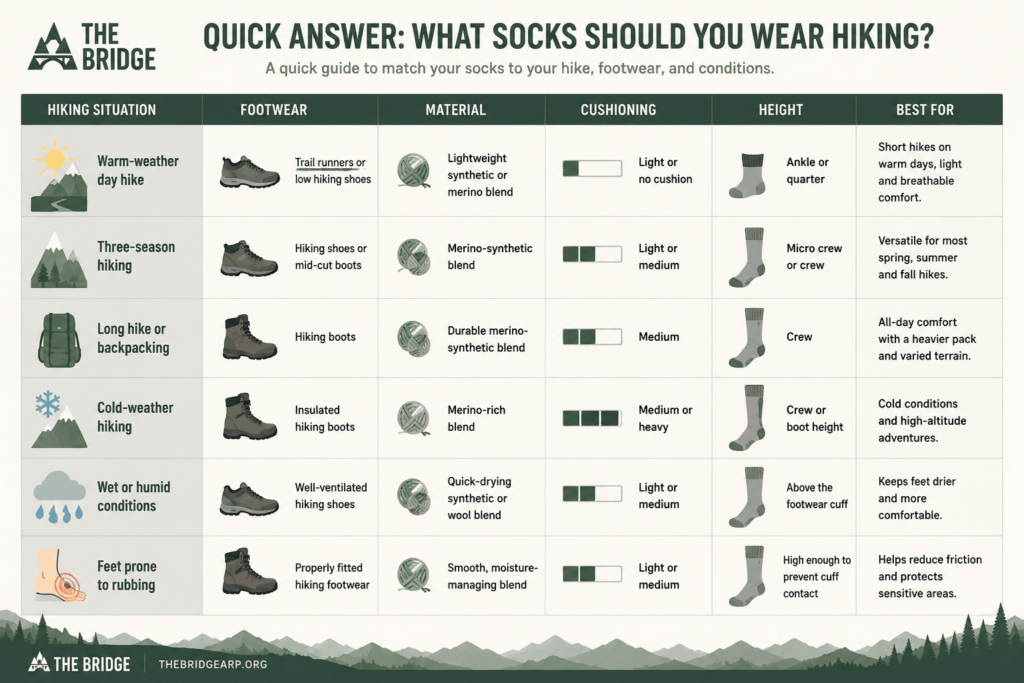
The table is a starting point, not a rulebook. Before buying the thickest or warmest option, check how much room your footwear has. A sock can have excellent materials and construction but still be uncomfortable if it changes the fit of your shoes.
Start With Your Hiking Footwear
Your hiking shoes or boots should determine the basic height and thickness of your socks.
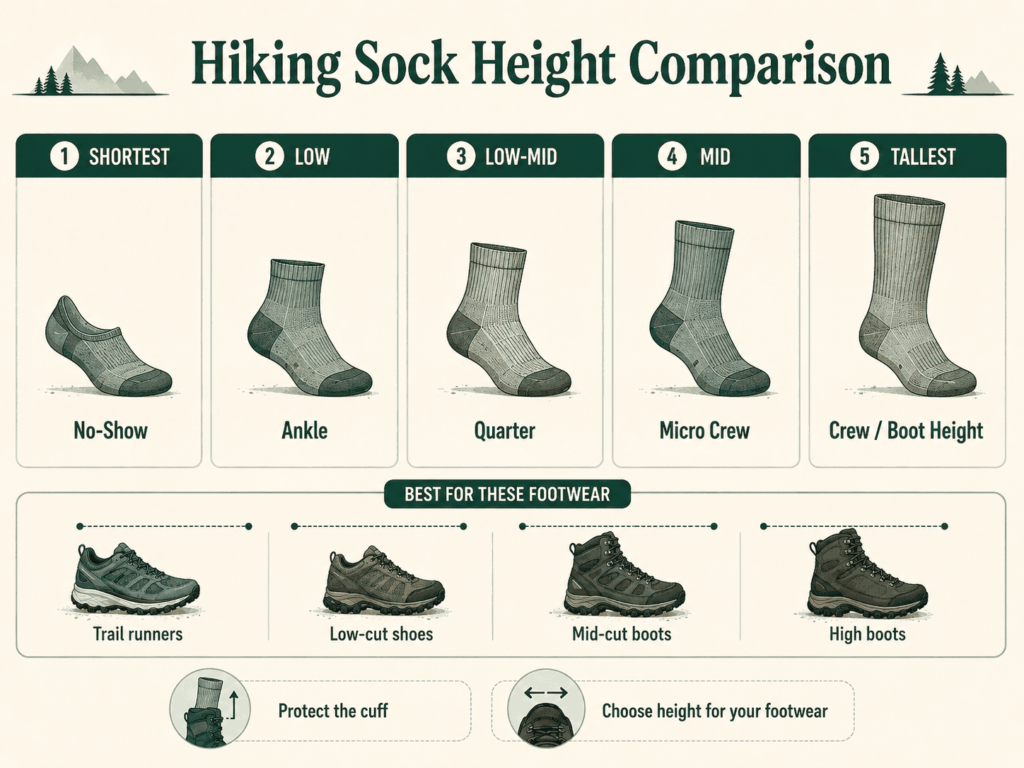
The first rule is simple: the sock should normally rise above the footwear cuff. This keeps the edge of the shoe or boot from rubbing directly against your skin. Low-cut socks work with low trail shoes, while mid-cut and high hiking boots usually require micro-crew or crew socks.
Thickness matters just as much. A cushioned sock takes up more space inside the shoe. If your boots already fit closely around the toes or forefoot, adding a thick sock can create pressure instead of comfort. If the footwear has more internal volume, a medium-cushion sock may improve the overall fit.
When trying on hiking footwear, wear socks with the same thickness and cushioning you plan to use on the trail. Check that your heel stays secure, your toes have enough room to move, and there is no uncomfortable pressure across the top or sides of the foot. Pay attention to any early rubbing or hot spots, as these can become more noticeable during a longer hike.
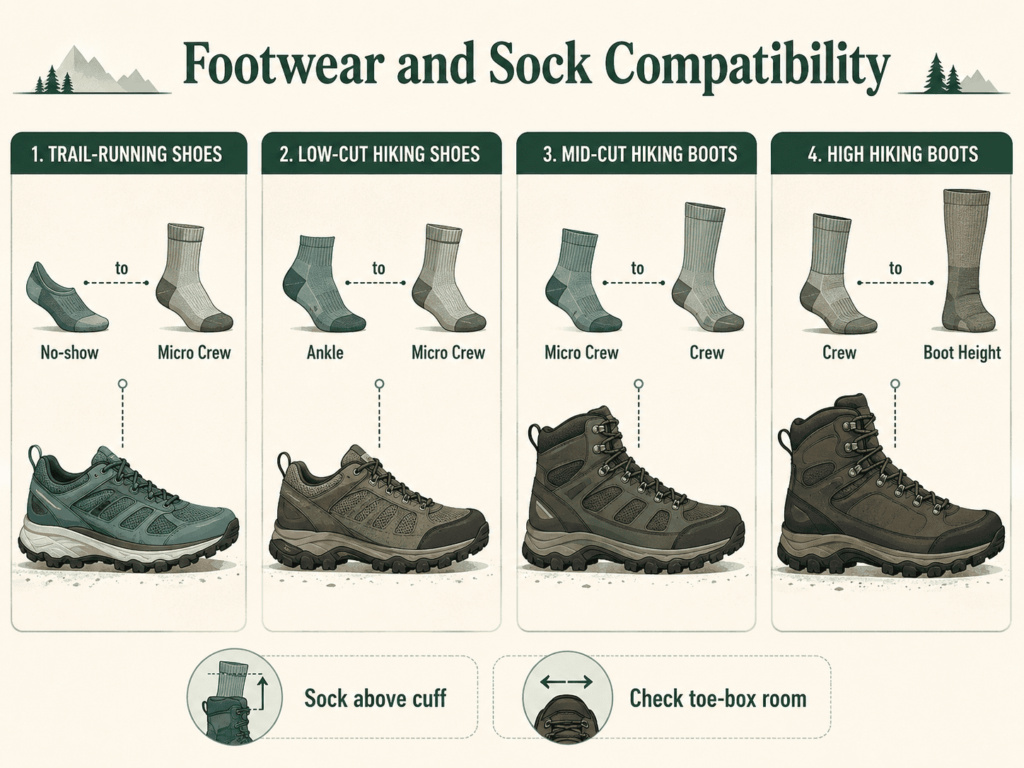
Use these general combinations:
- Trail-running shoes: no-show, ankle, quarter, or micro-crew socks.
- Low-cut hiking shoes: ankle, quarter, or micro-crew socks.
- Mid-cut hiking boots: micro-crew or crew socks.
- High hiking or mountaineering boots: crew, boot-height, or knee-high socks.
Do not use a thick sock to fix footwear that is much too large. Extra fabric can bunch or slide rather than create a secure fit. Similarly, a thin sock cannot make an overly tight shoe wide enough for your foot.
Choose the Right Hiking Sock Height
Sock height is partly a temperature preference, but its main practical job is to protect your skin from the footwear cuff, dirt, brush, and trail debris.
As a general rule, taller footwear requires taller socks. Crew socks are the most versatile option for many hikers because they usually extend high enough to protect the skin when worn with low-cut hiking shoes, mid-cut boots, and many high-cuff hiking boots.
No-Show Socks
No-show socks sit below or close to the top of low-cut shoes.
They offer minimal coverage and are best suited to trail runners or light hiking shoes on relatively clean trails. They are less suitable when the footwear collar touches exposed skin or when sand, small stones, or vegetation can enter the shoe.
Ankle and Quarter Socks
Ankle socks cover the ankle area, while quarter socks rise slightly higher.
They are a practical choice for:
- Trail-running shoes
- Low-cut hiking shoes
- Warm-weather day hikes
- Hikers who prefer less coverage around the lower leg
Check that the sock remains above every part of the shoe collar while walking uphill and downhill. A sock that appears high enough while standing may slide below the collar once you start moving.
Micro-Crew and Crew Socks
Micro-crew socks usually sit around the lower calf, while standard crew socks extend farther up the leg.
These are the most versatile choices for general hiking because they work with low-cut shoes, mid-cut boots, and many high-cuff boots. They also provide additional protection from brush and trail debris.
The trade-off is warmth. A higher sock covers more skin and may feel hotter during summer hiking, especially when combined with heavy cushioning.
Boot-Height and Knee-High Socks
Taller socks are mainly intended for high boots, mountaineering footwear, cold conditions, or activities where the shin and calf need protection from the boot.
Most beginner day hikers do not need knee-high hiking socks. Choose them because your footwear or conditions require the coverage—not because taller automatically means more technical or more protective.
What Is the Best Material for Hiking Socks?
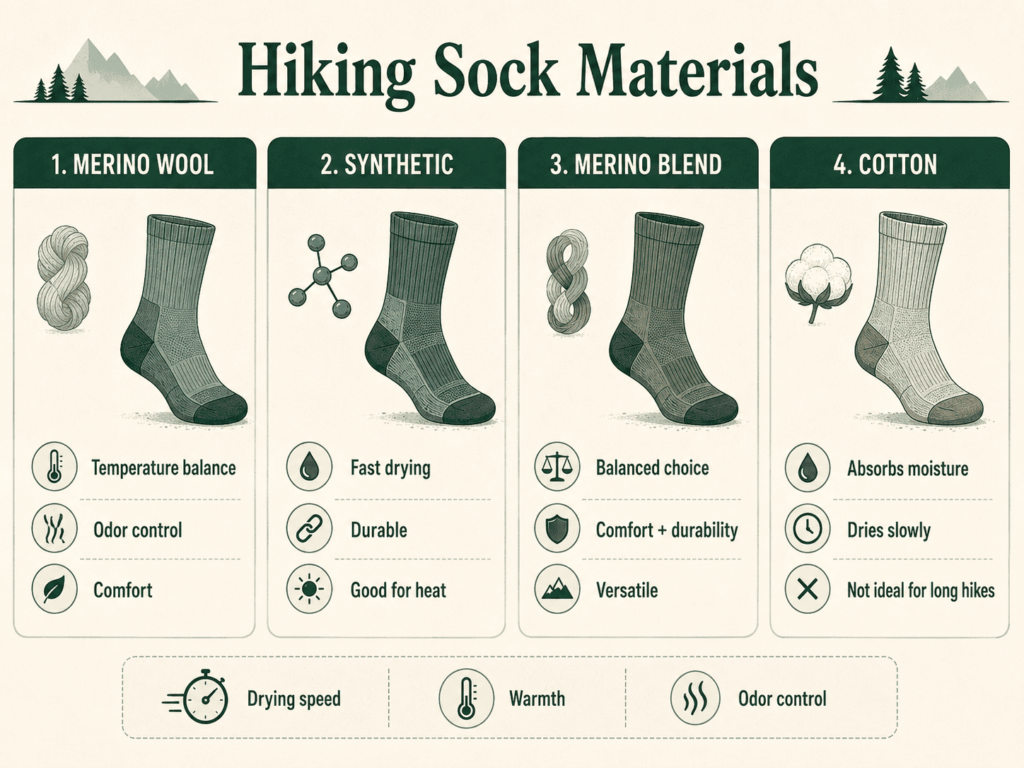
There is no single best hiking sock material for every hiker. The most useful socks usually combine several fibers so that each material performs a different job.
Many hiking socks blend:
- Merino wool for temperature and odor management
- Polyester for moisture movement and faster drying
- Nylon for durability
- Elastane, Lycra, or spandex for stretch and shape retention
Hiking socks are rarely made from a single material. Blended fabrics can combine comfort, warmth, durability, stretch, moisture management, and faster drying in one sock.
Merino Wool
Merino wool is one of the most common materials in hiking socks. It is generally softer than traditional coarse wool and is used in both lightweight summer socks and heavily cushioned cold-weather socks.
Its main advantages include:
- Good temperature regulation
- Better odor control than many synthetic fabrics
- Comfortable feel across a range of temperatures
- Insulation combined with breathability
- Suitability for multi-day use
Woolmark’s research reports that wool fabrics tend to retain less body odor after wear than polyester or cotton fabrics. This makes merino blends especially useful for backpacking trips where washing and changing socks may be difficult. (woolmark.com)
Merino is not perfect. High-merino socks are often more expensive and may dry more slowly than lightweight synthetic socks. Wool fibers can also wear faster in high-friction areas unless the sock includes nylon reinforcement.
Synthetic Materials
Synthetic hiking socks commonly use polyester, nylon, polypropylene, or branded moisture-management fibers.
Polyester is valued for moisture movement, insulation, and relatively fast drying. Nylon is frequently added to improve durability and help the sock maintain its structure. Elastane or spandex provides stretch and reduces loose fabric and wrinkling.
Synthetic socks can be a strong option for:
- Hot or humid hiking
- Hikers who prefer a wool-free sock
- Trips where fast drying is a priority
- High-output activities such as trail running
- Budget-conscious hikers
A possible disadvantage is odor retention. Synthetic fabrics may develop odors more quickly than wool, particularly during repeated wear.
Merino-Synthetic Blends
For many beginners, a merino-synthetic blend is the most balanced option.
Merino contributes temperature and odor management. Nylon or polyester improves strength and drying time. A small amount of elastic fiber helps the sock remain close to the foot.
Do not judge a sock only by its merino percentage. A higher percentage does not automatically mean a better hiking sock. Knit density, cushioning placement, fit, reinforcement, and the quality of the overall construction can be equally important.
Why Cotton Is Usually a Poor Hiking Choice
Cotton feels soft when dry, but it absorbs moisture and dries slowly. Once wet from sweat, rain, or a stream crossing, a cotton sock can remain damp against the skin.
Persistent moisture, combined with pressure and movement inside the shoe, can make friction problems more likely. The National Park Service recommends wool or synthetic moisture-wicking socks for longer hikes, particularly when prolonged moisture exposure is possible.
Cotton may be adequate for a very short, easy walk in dry conditions, but it is not a reliable choice for long hikes, backpacking, cold weather, or conditions where getting wet is likely.
Choose the Right Cushioning and Thickness
Cushioning describes how much padding is built into the sock. It also gives you a general indication of the sock’s thickness and warmth.
More cushioning is not always more comfortable. Thick socks take up more room, retain more warmth, and may increase sweating. The correct level depends on your footwear, weather, terrain, pack weight, and personal preference.
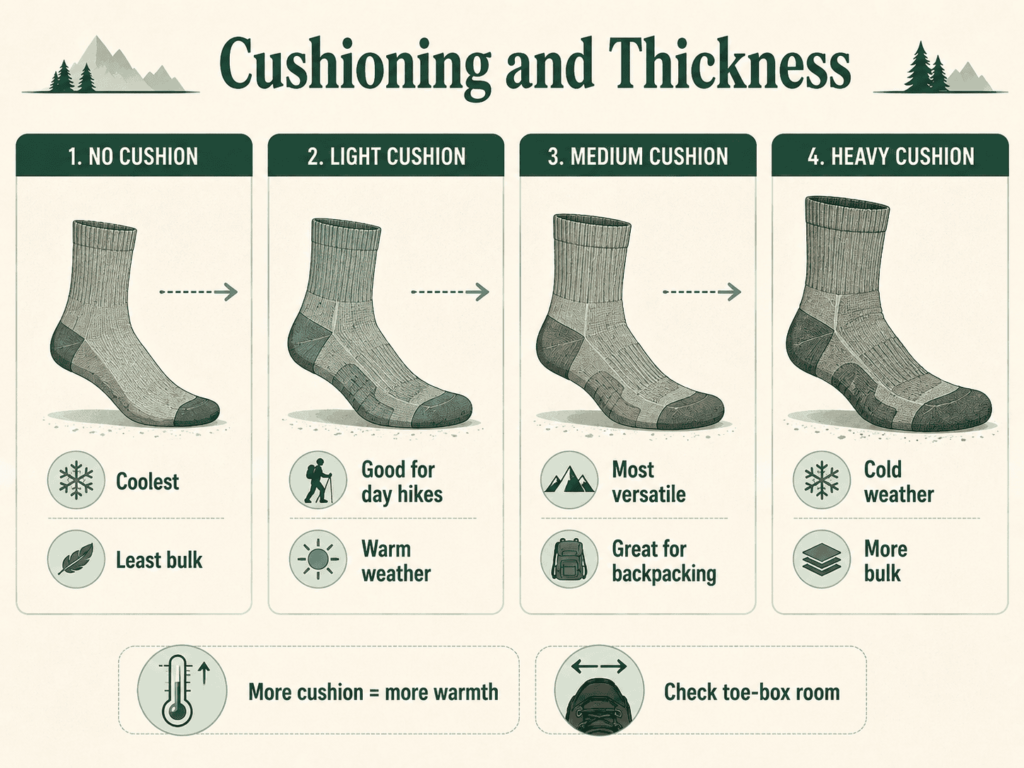
Hiking socks are commonly grouped into four cushioning levels: no cushion, light cushion, medium cushion, and heavy cushion. Lighter options are generally better for warm conditions and close-fitting footwear. Medium cushioning is a versatile choice for general hiking and backpacking, while heavy cushioning is mainly suited to cold temperatures, demanding terrain, and roomy mountaineering boots.
No Cushion or Ultralight
These socks have little padding and are designed for maximum breathability and minimum bulk.
They may suit:
- Hot-weather hiking
- Close-fitting trail shoes
- Short day hikes
- Hikers who dislike thick material underfoot
Because they provide little padding, footwear fit becomes especially important.
Light Cushion
Light-cushion socks usually place modest padding beneath the heel and ball of the foot while keeping the rest of the sock relatively thin.
They are a strong choice for:
- Warm or moderate temperatures
- Day hiking
- Trail-running shoes
- Well-fitted hiking shoes
- Hikers whose feet become warm quickly
Medium Cushion
Medium cushioning provides more padding beneath high-contact areas without reaching the bulk of a winter or mountaineering sock.
This is often the most versatile category for:
- General three-season hiking
- Longer day hikes
- Backpacking
- Rougher terrain
- Moderate or cool weather
- Carrying a heavier pack
Check that the additional material does not reduce toe space or create pressure across the forefoot.
Heavy or Full Cushion
Heavy-cushion socks are the thickest and warmest options. They are mainly designed for cold conditions, high boots, mountaineering, and footwear that has enough volume to accommodate the extra material.
They are often unnecessary for ordinary summer hiking. Inside a close-fitting boot, excessive thickness can restrict movement and create uncomfortable pressure points.
How Should Hiking Socks Fit?
Hiking socks should feel snug but not restrictive.
A correctly fitted sock stays close to the foot without loose folds, sliding material, or painful compression. The heel pocket should align with your heel rather than sitting below it or stretching toward the ankle.
Choose hiking socks based on your actual foot size and the manufacturer’s size chart, rather than relying only on your shoe size. Hiking shoes are sometimes purchased slightly larger to provide extra toe room, which can lead to choosing socks that are too large. Oversized socks may wrinkle, bunch, and rub, while undersized socks may create pressure, restrict movement, or slip out of position.
Check the following:
- The heel cup sits directly over your heel.
- The toe seam lies flat and does not press against the toes.
- There are no folds beneath the arch or forefoot.
- The cuff stays in place without cutting deeply into the leg.
- Your toes are not compressed after putting on your shoes.
- The sock does not rotate, slide, or bunch while walking.
- The footwear still has enough toe-box volume.
When you are between two sock sizes, the smaller option may reduce excess fabric, but it should not feel restrictive. Manufacturer size charts differ, so always check the specific chart for the sock you are buying.
A Simple At-Home Fit Test
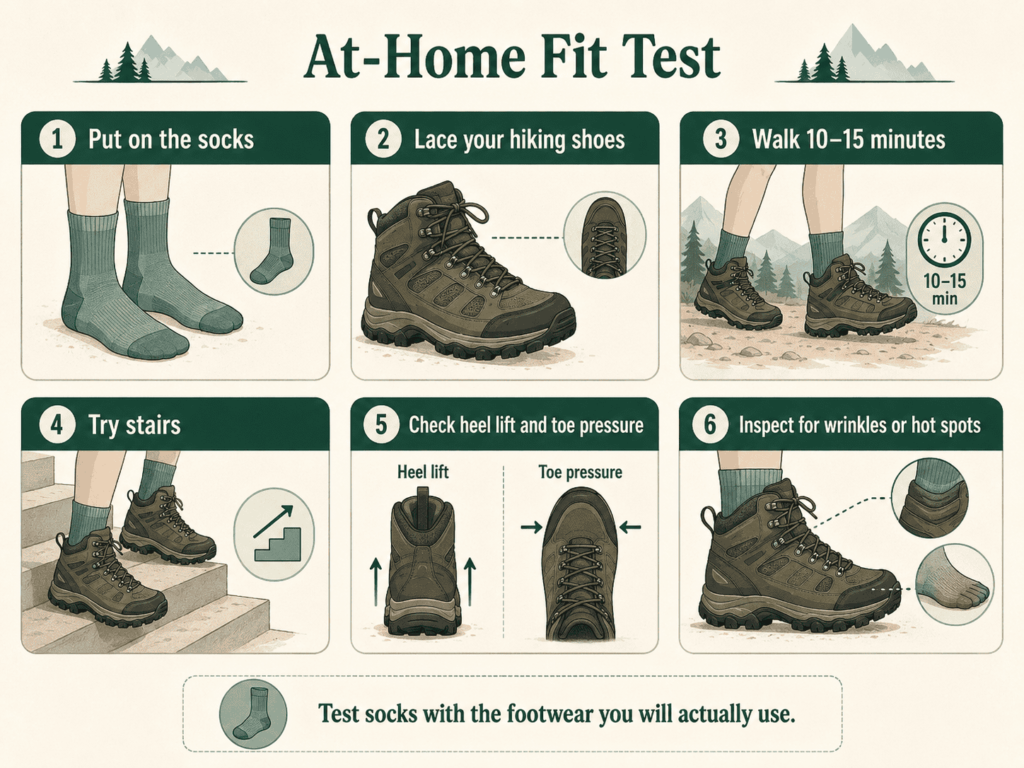
Test hiking socks with the actual footwear you intend to use.
- Put on the socks and smooth out the heel and toe areas.
- Lace your hiking shoes or boots normally.
- Walk indoors for 10 to 15 minutes.
- Go up and down a staircase if one is available.
- Pay attention to heel lift, toe pressure, rubbing, and bunching.
- Remove the shoes and inspect the sock for folds or areas that have shifted.
- Check your feet for pressure marks or irritated spots.
Do not make a long or difficult hike the first test of a new sock-and-footwear combination. A short local walk provides a safer opportunity to identify problems.
Match Your Socks to the Hike
Once the basic fit is correct, adjust material, cushioning, and height to the conditions.
Warm-Weather Day Hikes
Choose a lightweight sock with no cushioning or light cushioning. Synthetic or lightweight merino blends can both work, depending on which feels better on your skin.
Prioritize:
- Breathability.
- Fast drying.
- Minimal bulk.
- A height compatible with the shoe collar.
General Three-Season Hiking
For spring, summer, and fall hiking in moderate conditions, a merino-synthetic blend with light or medium cushioning is a reliable starting point.
A micro-crew or crew height works with most hiking shoes and mid-cut boots.
Long Hikes and Backpacking
Longer trips place more importance on moisture management, secure fit, durability, and comfort under repeated steps.
Medium cushioning may be useful, particularly with a heavier pack or rough terrain. The National Park Service also recommends bringing an extra pair of socks on longer hikes. Changing into dry socks can improve comfort when the first pair becomes wet. (nps.gov)
Cold-Weather Hiking
Choose a warmer merino-rich blend with medium or heavy cushioning, provided the footwear has enough room.
Avoid forcing a very thick sock into a tightly fitted boot. Compression can reduce the insulating air space around the foot and create pressure.
Wet Conditions
Moisture-wicking socks help manage sweat, but they cannot stop water entering through a non-waterproof shoe.
For occasional dampness, prioritize quick-drying materials and carry a dry pair. For repeated stream crossings, heavy rain, wet vegetation, or extended muddy conditions, read our guide to waterproof hiking socks and consider whether a waterproof sock system suits your footwear and expected temperature.
Feet Prone to Rubbing
No sock can compensate for badly fitting footwear. Start with a secure shoe fit, then select a smooth sock that remains in place.
Pay particular attention to:
- Heel alignment.
- Toe seams.
- Loose fabric.
- Dampness.
- Areas where the footwear presses or moves.
Some hikers prefer toe socks, double-layer socks, or liners. These are individual solutions rather than universal requirements and should be tested before a long trip.
Hiking Sock Features That Actually Matter
Hiking socks often include a long list of technical features, but each feature should solve a specific fit, comfort, moisture, or durability problem. Focus on the following details:
- Defined heel pocket.
A shaped heel helps the sock follow the foot and remain correctly positioned. The heel pocket should align with your heel without sitting below it or stretching toward the ankle. - Flat or seamless toe.
A bulky toe seam can create pressure or irritation inside footwear with limited space. A flat or integrated seam may be more comfortable, particularly for sensitive toes. - Reinforced heel and toe.
The heel and toe experience significant wear. Additional nylon or a denser knit can improve durability without adding heavy cushioning throughout the entire sock. - Targeted cushioning.
Some socks place extra padding beneath the heel, forefoot, or other high-contact areas. This can improve comfort while limiting unnecessary warmth and bulk elsewhere. - Ventilation zones.
Thinner mesh sections can reduce material and improve airflow in low-impact areas. Their effectiveness still depends on how breathable the hiking footwear is. - Supportive arch band.
An elastic band around the midfoot can help keep the sock in place and reduce movement. It should feel secure without creating uncomfortable compression. - Secure cuff.
The cuff should prevent the sock from sliding down while walking. It should not feel painful, restrict circulation, or leave unusually deep marks on the leg. - Anatomical construction.
Some brands produce separate left and right socks to improve shaping and cushioning placement. This can be useful, although a properly fitted standard sock may work equally well for many hikers.
Do You Need Liner Socks?
A liner sock is a thin sock worn beneath a thicker hiking sock. Traditionally, hikers used liners to help manage moisture and reduce friction between the foot and the outer sock.
Many modern hiking socks are designed to manage moisture and fit securely without an additional layer, so liner socks are optional for most hikers. They may still be useful for people who have tested them successfully and find that the extra layer improves comfort or reduces rubbing.
Consider liners when:
- You have successfully used them before.
- Your footwear has enough room for two layers.
- You want to test a different approach to friction management.
- You need a thin layer that can be changed or washed separately.
Avoid them when two layers make the shoe feel tight, create folds, compress the toes, or increase heat.
Common Hiking Sock Mistakes
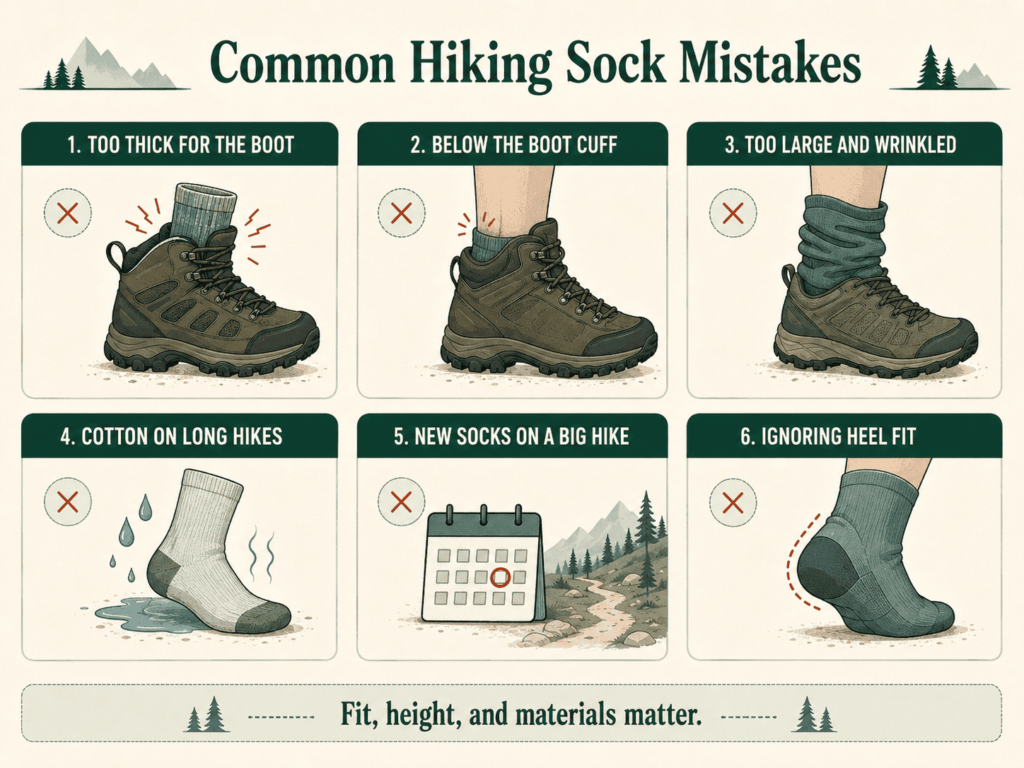
Even well-made hiking socks can cause discomfort when they do not match your footwear, foot shape, or hiking conditions. Avoid these common mistakes:
- Choosing socks without considering the footwear.
Your socks and hiking shoes should work as one system. A sock that is too thick, too thin, or too low for the footwear can create pressure, slipping, or rubbing. - Assuming more cushioning is always better.
Heavy cushioning can provide warmth and comfort in roomy boots, but it may increase sweating and create pressure inside close-fitting footwear. - Wearing socks below the boot cuff.
When the sock sits below the footwear collar, exposed skin can rub directly against the boot. Choose a height that remains above the cuff while walking. - Buying socks that are too large.
Oversized socks can wrinkle, slide, or collect around the toes and heel. The heel pocket should align with your heel, and the fabric should remain smooth against the foot. - Ignoring the heel position.
If the sock’s heel pocket sits below the heel or stretches toward the ankle, the size or shape may not be suitable for your foot. - Wearing cotton on long, wet, or cold hikes.
Cotton absorbs moisture and dries slowly, making it less reliable for extended hikes, cold weather, or conditions where your feet may become wet. - Testing new socks on a major hike.
Even a highly rated sock may not work with your feet and footwear. Test new socks on a shorter walk before relying on them for a long or difficult trail. - Treating waterproof socks as an everyday option.
Waterproof socks are specialized equipment for conditions where external water is the main problem. For ordinary hiking, they may add unnecessary warmth, stiffness, and bulk.
Beginner’s Hiking Sock Checklist
Before buying or packing your hiking socks, confirm the following:
- Identify your footwear.
Check the height of the cuff and the available room inside the shoe. - Choose enough height.
The sock should rise above the footwear collar. - Match the material to the conditions.
Choose merino for balanced temperature and odor management, synthetics for fast drying, or a blend for a combination of benefits. - Select cushioning carefully.
Use enough padding for the hike without overcrowding the shoe. - Check the fit.
Look for a smooth, snug fit with the heel pocket correctly aligned. - Test the whole system.
Wear the socks with your hiking footwear before taking them on a long trail.
Hikers looking for specific women’s models can also compare our selected hiking socks for women.