Choose a merino blend when odor between washes is your main concern. Choose a synthetic hiking sock when quick drying or avoiding wool matters more. Both can work for day hikes and backpacking. Thickness, cushioning, fit, and your shoes can change the result as much as the fiber label.
The useful comparison is usually a wool-containing blend versus a wool-free technical sock, rather than pure wool versus one synthetic fiber. This guide explains those tradeoffs so you can match a pair to your actual hiking conditions.
Research basis: We reviewed textile research and current manufacturer information. We did not conduct a wear test or measure drying times for this article. The recommendations below are practical interpretations of that evidence.
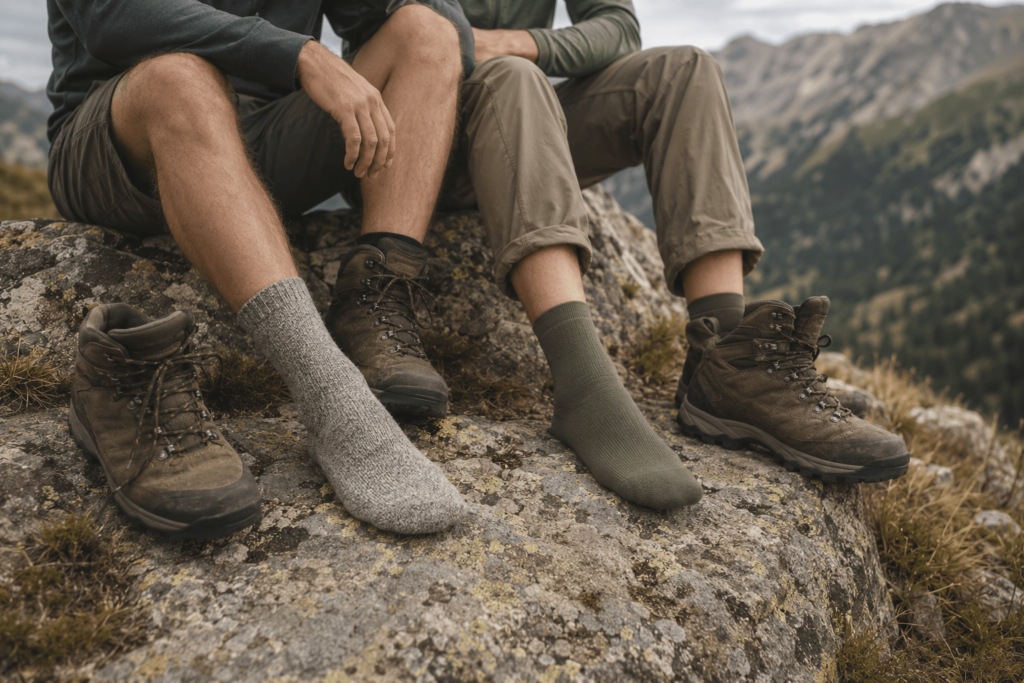
Merino vs Synthetic Hiking Socks: Quick Comparison
| What matters | Merino-containing blends | Synthetic hiking socks |
|---|---|---|
| Odor between washes | Often a useful starting point for repeated wear. | Polyester can retain more noticeable odor; fiber mix and finishes vary. |
| Drying after soaking | May take longer than a comparable quick-drying synthetic. | Useful when you need a rinsed or soaked pair to dry quickly. |
| Warmth | Available in thin summer styles and thicker insulated designs. | Also available in different weights; synthetic does not automatically mean cool. |
| Moisture inside boots | Wool can absorb moisture vapor; the whole sock and boot still matter. | Fast drying outside a boot does not guarantee drier skin inside it. |
| Durability | Look for reinforced wear areas and a secure fit. | Check construction and reinforcement, rather than assuming every synthetic lasts longer. |
| Comfort against skin | Try a fine merino blend if it feels comfortable to you. | A practical alternative if you prefer to avoid wool. |
| Price | Compare equivalent styles and current prices. | Not automatically cheaper than merino; brand and construction affect price. |
For sock height, cushioning, sizing, and footwear compatibility, start with our broader guide to choosing hiking socks. Here, the focus is the material decision.
What the Fiber Label Actually Tells You
A merino hiking sock can contain a substantial proportion of synthetic yarn. Nylon contributes durability, while elastane, also called spandex, supplies stretch. Textile Exchange describes nylon as a durable, stretchy performance fiber. Polyester is another common component; the organization identifies quick drying and strength among its properties.
Synthetic socks can combine nylon, polyester, acrylic, polypropylene, and stretch fibers. Those materials are not interchangeable. Look at the complete composition rather than treating every wool-free sock as the same fabric.
Two Real Hiking-Sock Labels
These two men's Darn Tough styles show why the product name alone is not enough. Both are listed as midweight micro-crew socks, but their compositions differ:
| Example | Listed composition | What it illustrates |
|---|---|---|
| Hiker Micro Crew Midweight, style 1466 | 61% merino wool, 36% nylon, 3% Lycra spandex | A merino sock is also a synthetic blend. |
| Hiker Micro Crew Synthetic, style 1931 | 37% nylon, 34% polyester, 26% acrylic, 2% elastane, 1% other fiber | A synthetic sock can use several different fibers. |
The manufacturer notes that percentages can vary slightly. These are label examples, not a head-to-head performance test or a ranking. Check the label on the exact pair you buy.
More merino does not automatically mean a better hiking sock. Two blends can also differ in yarn thickness, cushioning, ventilation panels, and reinforcement. Compare those features before using the wool percentage as a tie-breaker.
Drying Speed and Dry Feet Are Different Questions
Drying is how quickly a wet sock loses moisture. Wicking is how liquid moves through the yarn and knit. A third process is absorption within the fiber. They interact, but they describe different things.
Woolmark explains that wool absorbs and releases moisture vapor. That industry explanation helps describe the fiber, but it does not establish that a particular merino sock will keep every hiker drier.
For repeated soaking or overnight rinsing, a quick-drying synthetic is worth considering. Even merino-sock manufacturer Darn Tough acknowledges that some synthetic options dry faster than merino. A thick synthetic sock can still dry differently from a thin merino blend, so avoid assuming a fixed drying-time advantage.
Inside a closed boot, evaporation is restricted. A research review discussing sock moisture management describes a military-boot study in which a wool blend left some areas of the foot drier than a polypropylene sock. Other measured areas showed no difference. That limited result is useful because it challenges the assumption that low water absorption always means drier skin.
Practical takeaway: For stream crossings in ventilated trail shoes, prioritize a sock that can dry between soakings. For sweaty feet in waterproof boots, also consider thickness, fit, and the boot's limited ventilation. Changing fibers cannot create airflow that the footwear does not provide.
Odor: Merino Has a Useful, Qualified Advantage
Merino-containing socks are worth considering when you will rewear a pair between washes. In a study of nine apparel fabrics, polyester retained stronger underarm odor than wool and cotton. The researchers also found that odor intensity did not simply follow the number of bacteria present.
That experiment studied apparel fabrics, not hiking socks worn in boots. It supports an odor-related preference for wool, rather than a guarantee that every merino sock will smell better than every synthetic blend. A review of sweat and odor in sportswear also describes how fiber type, fabric structure, and odor compounds affect the outcome.
Our recommendation is to give a merino blend priority when limited washing is your main problem. Odor resistance does not mean a sock is sterile, antibacterial, or ready for unlimited wear. Rotate and wash pairs as conditions and the care instructions allow.
Warmth, Durability, and Comfort Depend on Construction
Warmth: Match the Weight to Your Footwear
Wool is not restricted to winter use, and synthetic does not mean summer-only. A thin merino blend can be an option for warm days. A heavier synthetic sock can add insulation. Start by matching the sock's bulk to the available room in your shoes or boots.
If a thick sock crowds your toes or changes the fit of a familiar boot, a different blend alone will not solve the problem. Compare similar cushioning and fabric weights before deciding which material feels better.
Durability: Check the Heel, Toe, and Fit
Nylon reinforcement is useful in both material categories, but the label cannot tell you how many hikes a pair will survive. Look at the heel and toe, how securely the sock holds its shape, and the manufacturer's care instructions. We have not measured the lifespan of either example above, so there is no supported cost-per-hike figure to compare.
Care and Comfort: Follow the Exact Pair's Instructions
Do not assume all merino requires hand washing or all synthetics tolerate high heat. For the two Darn Tough examples above, the manufacturer specifies a cold gentle wash, no bleach, and low-temperature tumble drying or hang drying. Other socks can have different instructions.
If a wool blend feels irritating, try a different construction or choose a wool-free pair. A short walk in your intended footwear is more useful than committing to a long trip based on a fabric claim.
Which Material Makes Sense for Your Hike?
| Your situation | A useful starting point | Check before committing |
|---|---|---|
| A multi-day trip with limited washing | Merino-containing blend | Comfort, drying opportunities, and a spare pair. |
| Frequent soaking with time to dry between crossings | Quick-drying synthetic | Comparable thickness and ventilation in the footwear. |
| A hot day in breathable trail shoes | A lightweight style in either category | Low bulk, smooth fit, and how your feet feel during a trial walk. |
| Sweaty feet in waterproof boots | Compare both materials in the same footwear | Moisture storage, sock thickness, and limited evaporation. |
| You prefer to avoid wool | Wool-free technical hiking sock | The full label, seam comfort, and heel fit. |
Ordinary merino and synthetic socks are not waterproof barriers. A purpose-built membrane sock is a separate choice; our waterproof hiking socks guide covers that category. It should not be treated as a substitute for choosing suitable footwear.
If rubbing is the main issue, begin with the fit and cushioning checks in our hiking sock guide. The blister-prevention review cited above does not support a universal promise that one fiber will prevent blisters.
How to Make the Final Choice
- Name your main problem. Repeated-wear odor points toward trying merino. Drying after soaking points toward trying a quick-drying synthetic. Avoiding wool points toward a wool-free blend.
- Compare similar constructions. Keep height, cushioning, and fabric weight reasonably close so you are not comparing a thin summer sock with a thick padded one.
- Use your actual hiking footwear. Check for bunching, heel movement, toe pressure, and seams you can feel.
- Try a short hike first. Notice dampness, rubbing, and drying after use. Choose the pair that works in that setup rather than chasing the highest wool percentage.
For many hikers, keeping one merino blend and one synthetic option is more useful than declaring a permanent winner. It lets you choose for the next trip and gives you a meaningful comparison in your own footwear.
Frequently Asked Questions
Do Synthetic Hiking Socks Dry Faster Than Merino?
Some do, especially styles designed for quick drying. Compare similar thicknesses and remember that a sock drying on a line behaves differently from one enclosed in a boot. We did not measure a drying-time difference for this comparison.
Are Merino Wool Socks Too Warm for Summer Hiking?
Not automatically. A lightweight merino blend may suit warm-weather hiking. Fabric weight, cushioning, shoe ventilation, and personal comfort should guide the choice rather than the word wool alone.
What Percentage of Merino Wool Is Best for Hiking Socks?
There is no single percentage established as best for every hike. Reinforcement, stretch, cushioning, and fit also matter. The 61% merino label example above illustrates a blend, not a recommended minimum.
Are Synthetic Socks Better for Sweaty Feet?
They can be useful when quick drying is the priority. They are not guaranteed to keep skin drier in every boot. Compare the complete sock-and-footwear setup, especially when waterproof footwear limits evaporation.
Do Merino Socks Prevent Blisters?
No material guarantees blister prevention. Sock construction, moisture, footwear fit, and repeated rubbing all influence the situation. Choose a smooth, secure fit and address discomfort rather than relying on a material label.
Are 100% Merino Socks Better Than Blends?
Not necessarily. Synthetic reinforcement and stretch fibers can be useful features in a hiking sock. Evaluate the whole construction instead of treating the absence of synthetics as an advantage.
Sources and Method
Manufacturer compositions and care instructions were checked on October 15, 2026. Product labels can change. Manufacturer pages establish what a brand lists; the research papers provide broader material evidence. Neither replaces a wear test of the exact socks in your footwear.
- Darn Tough: men's style 1466 and men's style 1931, composition and care.
- Textile Exchange: polyester and nylon, fiber properties.
- Woolmark: wool fiber properties, industry information about moisture vapor.
- Darn Tough: moisture-wicking and drying discussion, manufacturer perspective.
- McQueen et al.: Odor Intensity in Apparel Fabrics and the Link with Bacterial Populations, 2007 study.
- Sweat and odor in sportswear: A review, research synthesis.
- Friction Blisters of the Feet: A Critical Assessment of Current Prevention Strategies, evidence review.